New apartment kitchen checklists have a way of ballooning into 80-item shopping lists that cost more than your first month’s groceries. You don’t need most of it. What you need is enough to cook real meals, wash up, and store leftovers, and you can add the rest as specific recipes demand it.
This checklist splits your kitchen into three tiers: buy-first essentials you’ll use in week one, add-soon items worth getting in your first month, and the “skip for now” list of things people buy that just sit in a drawer. Print it, cross off what you already own, and you’re set.
The Short Answer: Your Week-One Kitchen
If you cook even occasionally, this is the core. Everything here earns its place because you’ll reach for it within days:
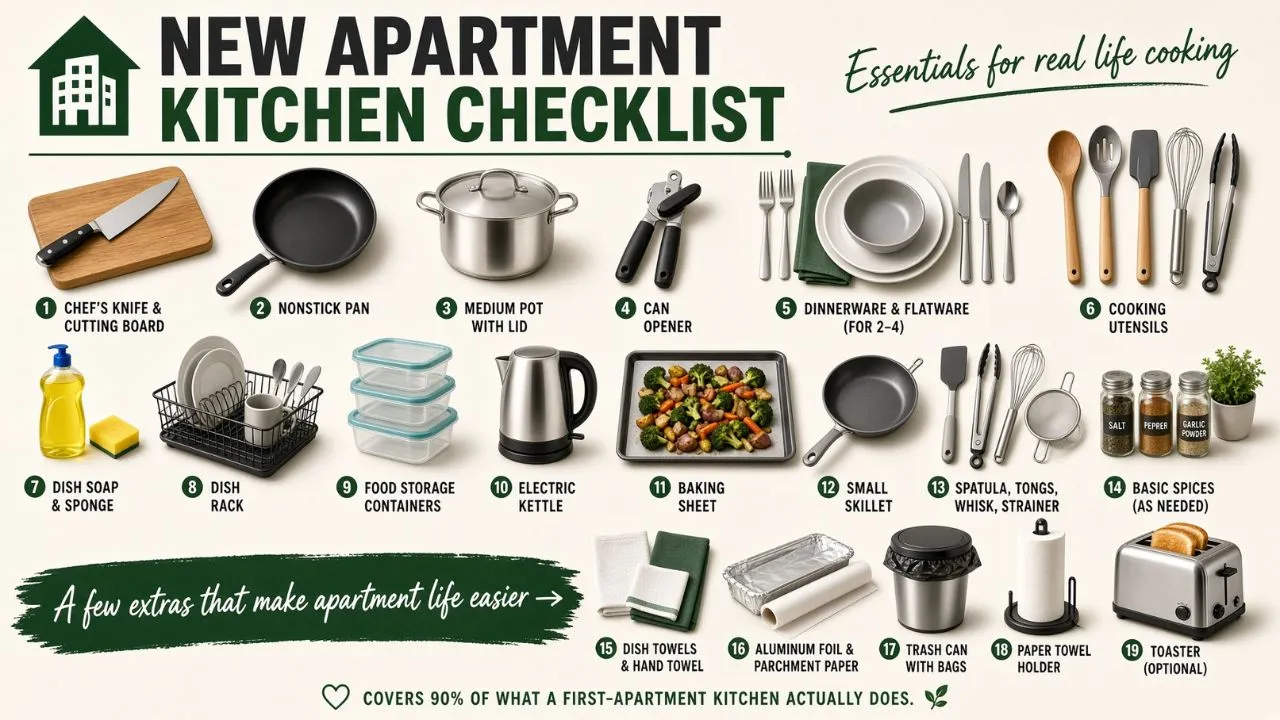
A chef’s knife, a cutting board, one nonstick pan, one medium pot with a lid, a can opener, dinnerware and flatware for two to four, a few cooking utensils, dish soap and a sponge, a dish rack, food storage containers, and either a coffee maker or an electric kettle. That’s roughly a dozen items and it covers 90% of what a first-apartment kitchen actually does.
Keep the fuller version handy too: our first apartment kitchen essentials guide breaks each category down further.
Tier 1: Buy these first (week one)
These are the non-negotiables. Get them before you unpack the rest of the apartment.
- Cookware: One nonstick pan handles eggs, sautés, and most weeknight cooking. One medium pot with a lid covers pasta, rice, soup, and anything you boil. That’s genuinely enough to start. A single 8-inch chef’s knife outperforms a whole block of dull knives, so buy one decent knife rather than a cheap set.
- Prep and serving: A cutting board, one mixing bowl (which doubles as a salad and serving bowl), a colander, and a can opener. Add a set of measuring cups and spoons if you follow recipes.
- Eat and drink: Dinnerware and flatware for two to four people. A four-person set usually costs about the same as a two-person set and means you’re ready for guests. Add a couple of glasses and mugs.
- Clean-up: Dish soap, a sponge or dish brush, a dish rack or drying mat, and a few kitchen towels. This is the part everyone forgets and then needs an hour after moving in.
- Storage and fuel: A handful of food storage containers (leftovers are how you stop bleeding money on takeout, which is one of the classic ways renters waste money), plus your coffee maker or kettle if caffeine is load-bearing in your morning.
Tier 2: Add soon (first month)
Once the basics are in, these fill out a working kitchen without cluttering it:
A baking sheet (roasting vegetables and sheet-pan dinners are cheap-cook gold), a second pan or a small skillet, a spatula, tongs, and a whisk if you didn’t get them in tier one, a strainer or fine sieve, basic spices bought as recipes call for them rather than a full rack at once, dish towels and a hand towel, aluminum foil and parchment paper, a trash can with bags, and a paper towel holder. Add a toaster if you’re a toast-and-bagel household.
Buy tier two gradually. There’s no prize for a fully stocked kitchen on day three, and spacing it out keeps your first-apartment budget intact.
What to Skip (For Now)
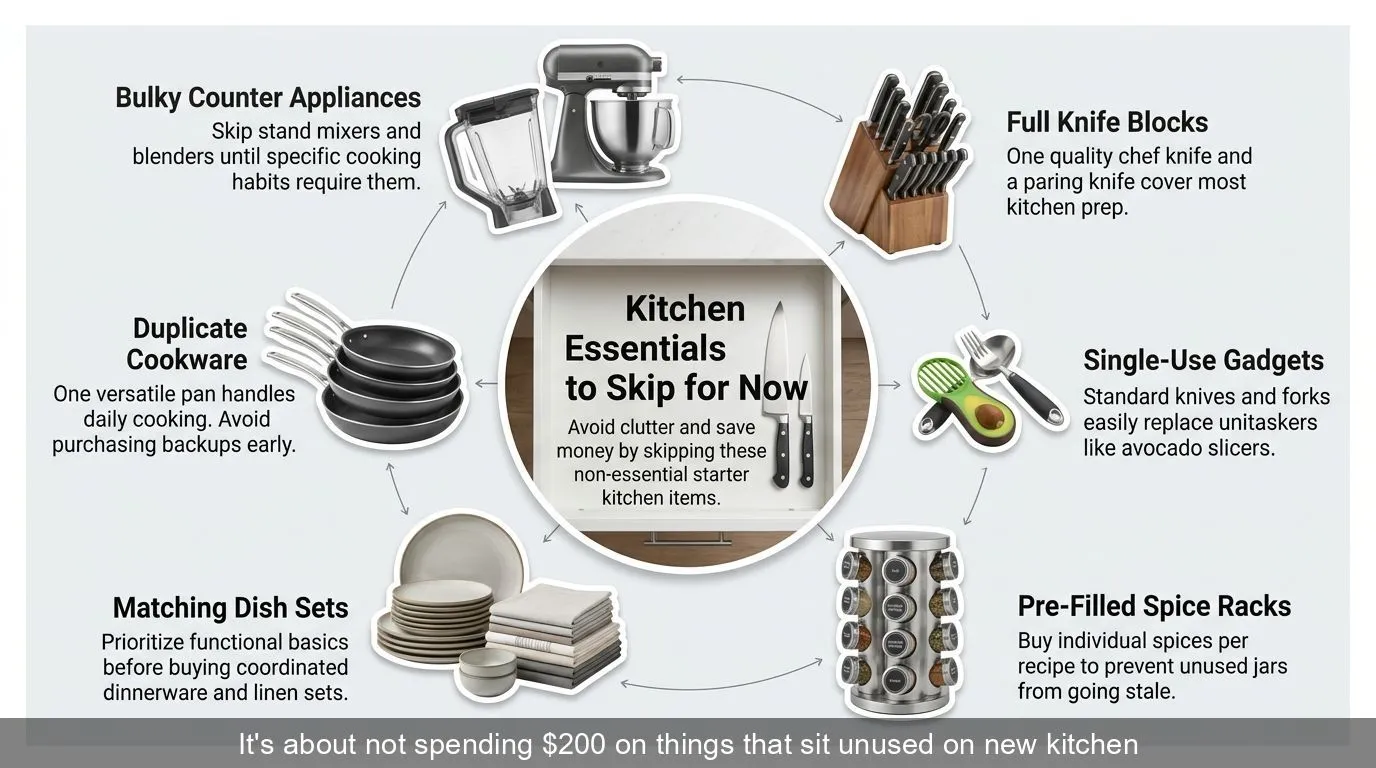
Here’s where most kitchen checklists lose the plot. These items are genuinely useful for some people and pure clutter for most first-time renters:
- Stand mixer, food processor, blender — unless you already have a specific habit that needs one, these are big, expensive, and counter-hogging. Buy them the week you actually need them.
- A full knife block — one good knife plus a paring knife covers almost everything. The steak knives and cleaver can wait.
- Specialty gadgets — garlic press, avocado slicer, egg separator, quesadilla maker. A knife and a fork do all of these jobs.
- A full spice rack — you’ll use five spices constantly and let fifteen others go stale. Buy spices per recipe.
- Matching everything — a coordinated dinnerware-plus-serveware-plus-linens set is a want, not a need. Function first.
- A second of anything you already have one of — one good pan is fine until it isn’t.
Skipping these on day one isn’t about deprivation. It’s about not spending $200 on things that’ll sit unused while you’re still figuring out how you cook in this kitchen.
Small Kitchen Reality Check
First-apartment kitchens are usually short on both storage and counter space, so what you buy matters less than where it goes. Nesting bowls, stackable containers, and a magnetic knife strip or an over-the-cabinet rack free up drawers you don’t have. If your rental kitchen feels cramped or dated, our renter-friendly kitchen upgrades covers the reversible fixes (no drilling, no lost deposit) that make a tight kitchen work harder.
One more small-kitchen rule: every item you buy needs a home before it comes through the door. If there’s nowhere to put the second mixing bowl, it lives on the counter and the counter is already your only workspace.
Frequently Asked Questions (FAQs) on New Apartment Kitchen Checklist
1. What do you need for a new apartment kitchen?
The week-one essentials are a chef’s knife, a cutting board, one nonstick pan, one pot with a lid, a can opener, dinnerware and flatware for two to four, a few cooking utensils, dish soap and a sponge, a dish rack, food storage containers, and a coffee maker or kettle. That covers almost everything a first kitchen does.
2. How much does it cost to stock a first apartment kitchen?
A functional week-one kitchen usually runs $100 to $250 buying new and basic, less if you shop secondhand for cookware and dinnerware. Spacing purchases over your first month keeps the cost manageable and prevents buying gadgets you won’t use.
3. What kitchen items are a waste of money for a first apartment?
For most first-time renters, a stand mixer, food processor, full knife block, single-use gadgets, and a full spice rack are money that sits in a drawer. Buy specialty appliances only when a habit actually requires them.
4. Should I buy a matching kitchen set?
No need. Matching dinnerware and cookware sets look nice but cost more and lock you into one style. A mix of well-chosen individual pieces does the same job for less, and you can add coordinating items later.
About The Author