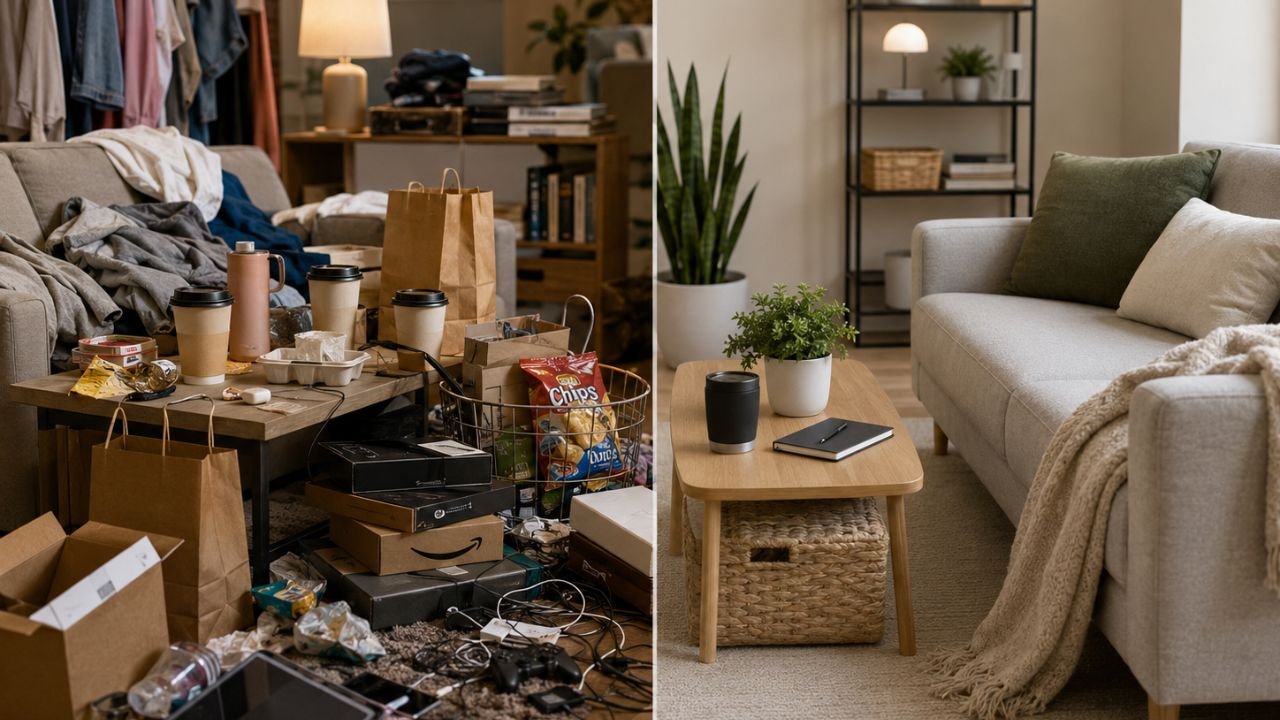
Renting is already expensive — the average American renter spends 30%+ of their income on rent before utilities, groceries, or anything else. The frustrating part is that the things renters waste money on a second front: spending on their apartment in ways that either don’t transfer when they move, or don’t last long enough to justify the cost.
This is a practical roundup of renter money saving tips — 13 of the most common renter budget mistakes, with the smarter alternatives that actually save money over time. The thread connecting all of these: anything you spend on a rental should either move with you, come off cleanly when you leave, or pay for itself within your lease term. Anything else is money lost.
The price ranges below reflect typical retail figures as of 2026, based on research across major retailers (Amazon, Home Depot, IKEA, Target, Facebook Marketplace) and consumer finance reporting.
1. Permanent Light Fixture Replacements
That ugly nipple-style ceiling fixture is one of the most common renter complaints — and one of the most common impulse “fixes.” Replacing it with an $80–$150 modern fixture means either hiring an electrician or risking your security deposit on a DIY swap, then reversing the entire process at move-out. You pay for the fixture twice: once to install, once to revert.
Buy instead: Plug-in floor lamps and statement table lamps ($30–$80 each). A well-placed pair of warm-toned floor lamps does more for a room’s atmosphere than a single ceiling fixture upgrade — and they move with you. For the existing fixture, swap to soft-white 2700K LED bulbs ($3–$5); the right bulb temperature does more visual work than most renters realize.
Estimated savings: $200–$400 per apartment.
2. Wall-Mounted TV Setups
Mounting a TV looks clean in theory — until move-out, when you’re patching, sanding, priming, and repainting four anchor holes. Renters often spend $50–$150 in repair supplies or lose that amount from their deposit. The mount itself ($40–$120) rarely transfers cleanly to the next apartment, since wall layout and stud spacing differ.
Buy instead: A freestanding TV stand or low media console ($80–$250). Modern options have built-in cable management, transfer to any apartment, and skip the wall-damage problem entirely. If you specifically want the “floating TV” look, a slim console with the TV centered above gets you 80% of the aesthetic without the drywall surgery.
Estimated savings: $100–$300 in deposit risk and reinstall costs.
3. Custom-Cut Window Treatments
Apartment windows are rarely standard sizes. Renters often spend $80–$200 on made-to-measure curtains or blinds that fit one apartment perfectly and the next not at all. The next tenant inherits your investment.
Buy instead: Adjustable curtain rods plus standard-size curtain panels (84″, 95″, 108″). Standard panels at $20–$40 a pair fit most windows with minor adjustment, and they re-use in 90% of future apartments. For privacy without curtains, removable static-cling window film ($15–$25 per window) handles bathrooms and street-facing bedrooms.
Estimated savings: $100–$200 per move.
4. Cheap Flat-Pack Furniture That Won’t Survive Two Moves
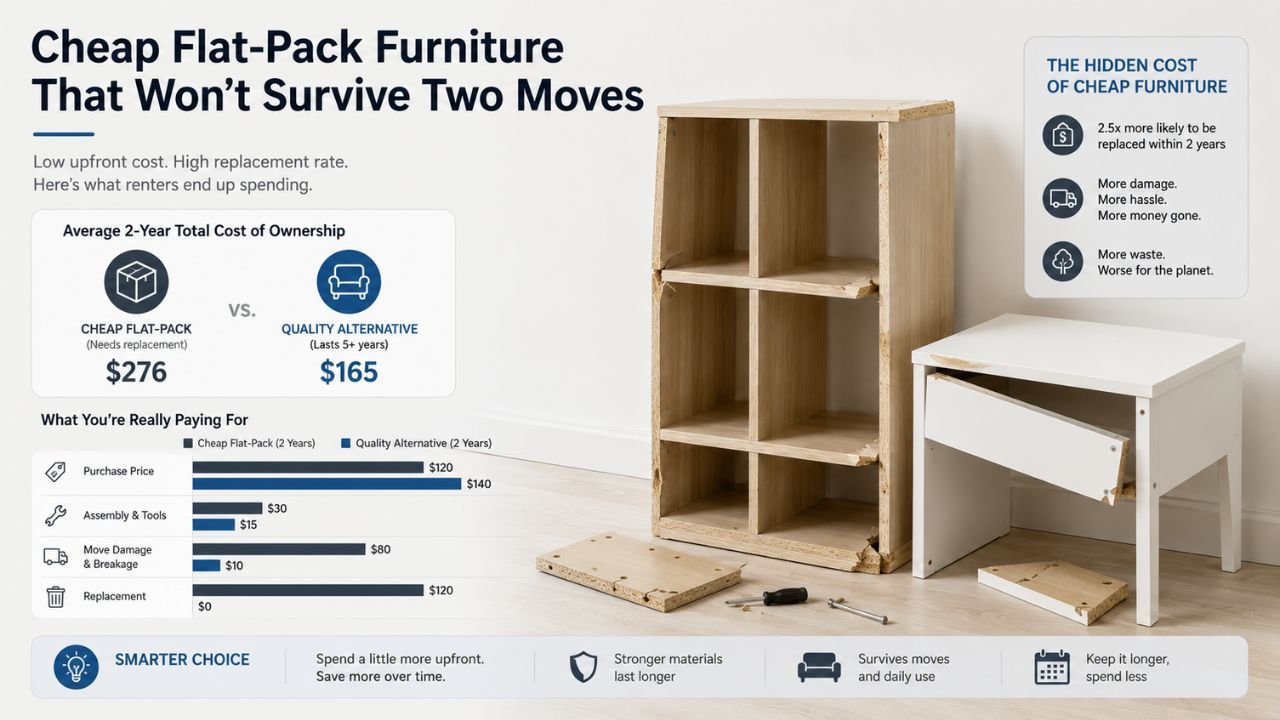
The $79 particleboard dresser is one of the most expensive purchases a renter can make over five years — because particleboard furniture is essentially single-move. The screws strip, the laminate chips, and the back panel detaches the moment movers tip it sideways. Most renters end up replacing it within one or two apartments.
Buy instead: Solid wood furniture from Facebook Marketplace, Craigslist, estate sales, or thrift stores. A real wood dresser in good condition typically runs $80–$200 — the same price as new particleboard — and lasts indefinitely. Look for dovetail joints in the drawers as a quality indicator.
Estimated savings: $300–$600 across a typical renter’s furniture lifecycle.
5. Designer Paint Jobs
The accent wall is a classic example of things renters shouldn’t buy without thinking about move-out. The paint costs $40–$60. Repainting back to landlord-spec white at move-out costs another $40–$60 plus a weekend, or $200–$400 if you hire someone, or your security deposit if you skip it.
Buy instead: Removable peel-and-stick wallpaper ($30–$80 per accent wall) or large-format framed art ($40–$150). Both deliver visual impact equivalent to (or greater than) paint, both come off cleanly, and both move to the next apartment. If you do want paint, ask your landlord first — some allow it without requiring a return-to-white at move-out.
Estimated savings: $80–$400 per apartment.
6. Wall-Fixed Shelving and Mirrors
Anchored floating shelves and mounted mirrors require drilling, anchoring, and eventual patching. Anchor holes are larger than nail holes — they need more substantial spackle work, and they’re harder to hide during move-out inspection.
Buy instead: Leaning shelves and leaning floor mirrors ($40–$150). Leaning mirrors have become a design trend in their own right — they make rooms feel larger and don’t put a single hole in the wall. For shelving, freestanding bookcases, over-the-door organizers, and tension-rod systems handle most renter storage needs without permanent mounting.
Estimated savings: $50–$150 in wall repair and lost deposits.
7. Built-In Closet Organization Systems
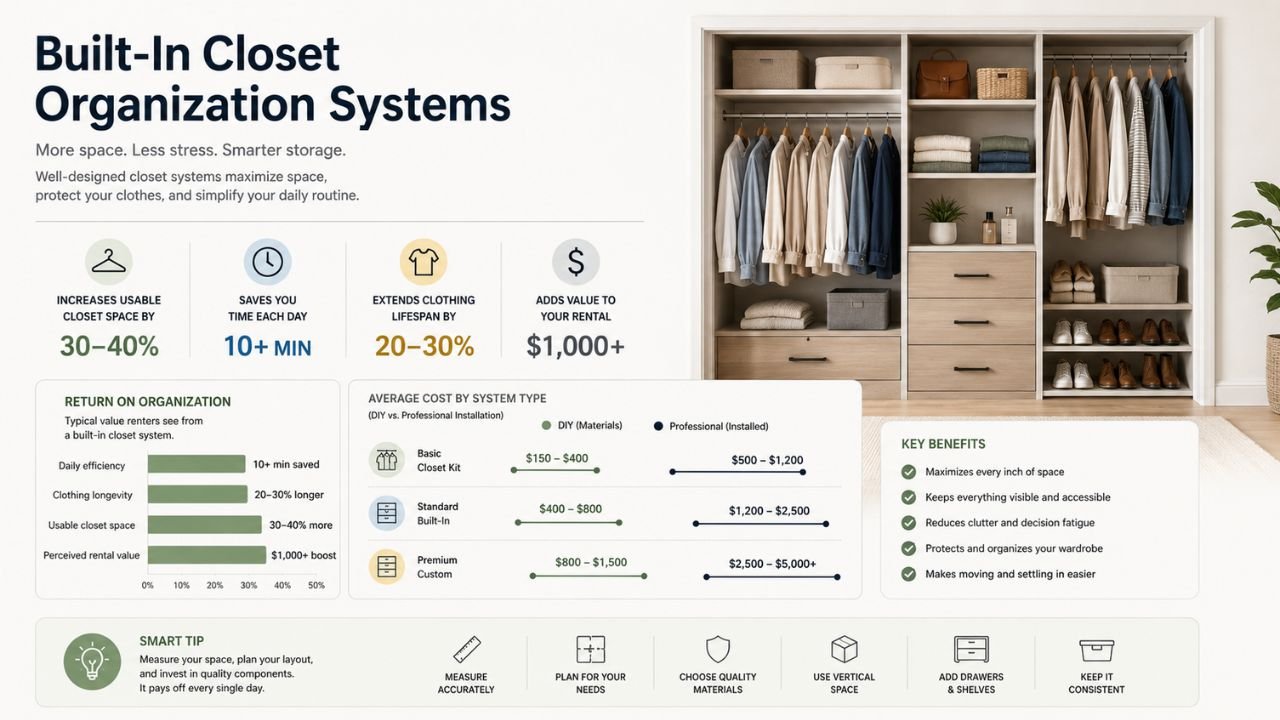
Custom closet systems from The Container Store or California Closets can run $300–$1,500, and most require either drilling into closet walls or being permanently anchored. They almost never transfer cleanly to the next apartment — different dimensions, different layouts, different wall depths. Overpriced furniture is the #1 trap — compare IKEA vs Wayfair before spending.
Buy instead: Modular freestanding closet organizers ($40–$120), hanging cube organizers from existing rods, or IKEA’s freestanding wardrobe systems. These give 80% of the function at 20% of the cost — and they’re designed to disassemble and rebuild in a new space.
Estimated savings: $250–$1,200.
8. Single-Purpose Kitchen Appliances
The waffle maker, the egg cooker, the panini press, the quesadilla maker, the rice cooker, the slow cooker, the stand mixer. Most renter kitchens are small, and most of these appliances live in cabinets unused 360 days a year.
Buy instead: A quality multi-cooker (Instant Pot or similar, $80–$120) replaces 6+ single-function appliances. A cast iron skillet replaces panini presses, egg cookers, and most quesadilla makers. A good chef’s knife and cutting board replace most “easy slicer” gadgets. The principle: in a small kitchen, every appliance needs to earn its counter or cabinet space.
Estimated savings: $200–$500 in unused gadgets.
9. Cheap Power Strips and Extension Cords
The $4 power strip with no surge protection is one of the few renter purchases that can actively cost you money — by failing during a power surge and taking your electronics with it. A single TV or laptop loss erases years of cheap-strip savings.
Buy instead: A real surge protector with a published joule rating ($20–$35). Look for at least 2,000 joules and a manufacturer warranty that covers connected equipment. The warranties on better strips typically cover $25,000–$300,000 in connected electronics if the unit fails.
Estimated savings: Potentially the cost of every electronic device you own.
10. Tools for One-Time Projects
Buying a power drill, stud finder, level, and step ladder just to hang a few things in a new apartment runs $80–$200. Most renters use these tools twice and store them for years.
Buy instead: Tool rental from Home Depot or Lowe’s ($10–$25 per day) for power tools you’ll use rarely. For basic hand tools, a single quality multi-tool plus a small hammer-and-screwdriver set ($25–$40 total) handles 90% of routine renter tasks. Many cities also have tool libraries that lend tools for free with a membership.
Estimated savings: $100–$200 per move.
11. Renter’s Insurance Through the Landlord’s Preferred Provider
When landlords require renter’s insurance, they often funnel tenants to a single preferred provider — usually a partner that pays them a referral fee. These policies are typically priced at $15–$25 per month for basic coverage.
Buy instead: Direct policies from major insurers (Lemonade, State Farm, Geico, Progressive) typically start at $5–$12 per month for equivalent coverage. Bundling with auto insurance often drops it further. Most landlords accept any compliant policy as long as they’re listed as an “interested party” on the certificate.
Estimated savings: $100–$200 per year.
12. Off-Site Storage Units
Storage units are one of the highest-margin businesses in real estate for a reason — most people who rent them stop opening them. Average storage unit prices run $90–$300 per month. After two years, that’s $2,000–$7,000 spent storing items often worth less than the cumulative storage cost.
Buy instead: Honestly assess what’s in the unit. The two-year rule applies: anything stored for two years without being touched is no longer functionally yours — it’s just paid for. Sell, donate, or trash the contents, and use vertical home storage (over-door, under-bed, ceiling-mounted) for what genuinely needs to stay.
Estimated savings: $1,000–$3,000 per year.
13. Single-Surface Cleaning Products
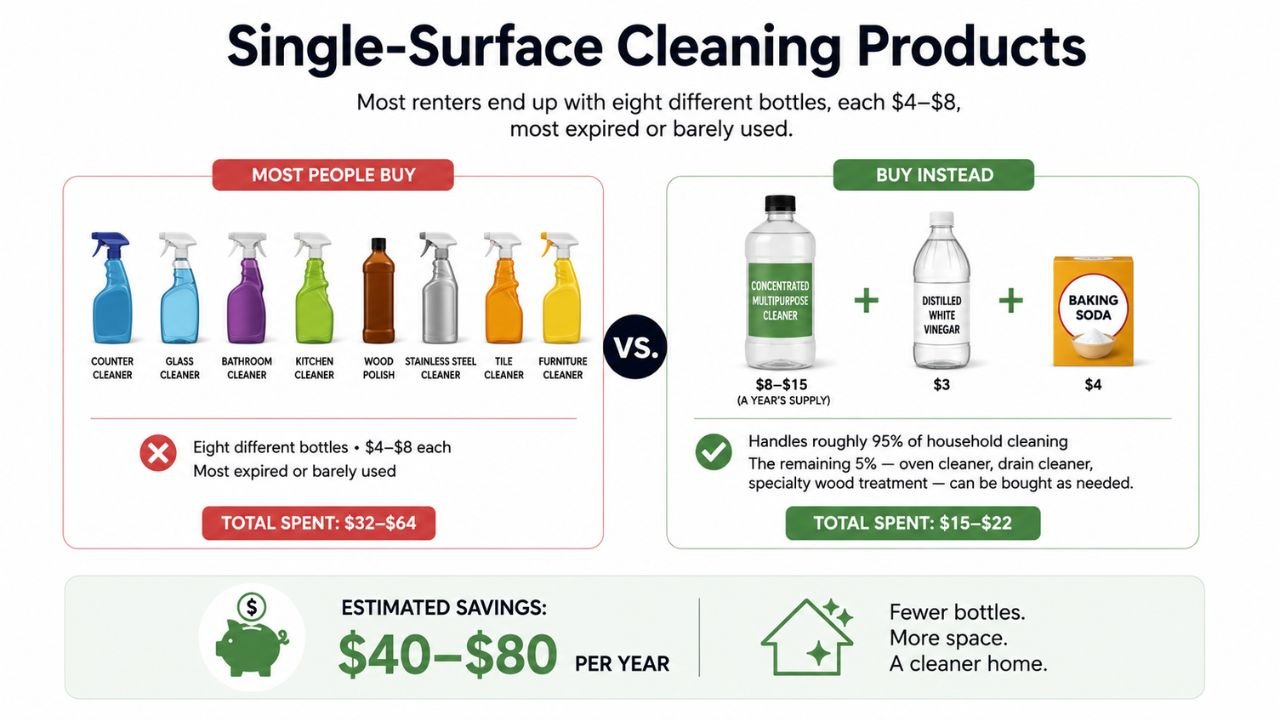
Counter cleaner, glass cleaner, bathroom cleaner, kitchen cleaner, wood polish, stainless steel cleaner — most renters end up with eight different bottles, each $4–$8, most expired or barely used.
Buy instead: A single concentrated multipurpose cleaner ($8–$15 for a year’s supply) plus distilled white vinegar ($3) and baking soda ($4) for tougher jobs. This combination handles roughly 95% of household cleaning. The remaining 5% — oven cleaner, drain cleaner, specialty wood treatment — can be bought as needed rather than stockpiled.
Estimated savings: $40–$80 per year.
The Quick Test: Is This Purchase a Renter Money Trap?
Before any apartment-related purchase over $50, three quick questions catch most of the mistakes above:
1. Will this physically move with me? If the answer is no — because it’s mounted, hardwired, custom-cut, or built-in — the cost has to be justified by your remaining lease term alone. A $200 light fixture you’ll enjoy for eight months costs $25 per month of use, not $200 once.
2. Will this fit my next apartment? Standard-size items (curtain panels, freestanding furniture, modular shelving) almost always do. Custom-fit items (made-to-measure blinds, built-in closet systems, oversized statement furniture for one specific corner) usually don’t. The next apartment will have different dimensions — plan accordingly.
3. Could I borrow, rent, or buy this used? For tools used once or twice per year, rental is almost always cheaper than ownership. For furniture, secondhand markets consistently offer better quality at lower prices than new flat-pack equivalents. Cleaning supplies, kitchen gadgets, and seasonal items are the categories where renters most often over-buy new.
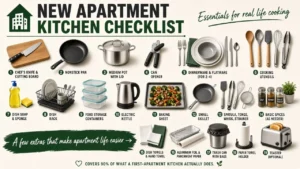
These three questions don’t catch every bad purchase, but they catch the expensive ones. Most renter budget mistakes share the same root cause — treating the apartment as if it were a permanent home — and the same fix: keep purchases modular, portable, and reversible. You could also stick to my complete first apartment checklist. It covers only what you truly need.
Where the Real Savings Are
Of the 13 categories above, the biggest single wins for most renters are:
- Skipping the storage unit — $1,000–$3,000 per year
- Switching renter’s insurance — $100–$200 per year, recurring
- Choosing secondhand furniture — $300–$600 over a few years
- Breaking the wall-mount habit — $200–$700 in deposit and repair costs
Combined, even moderately disciplined renters can save $2,000–$5,000 over a typical two-year lease period without lowering their standard of living. The pattern in all of these renter budget mistakes is the same: spending money on a permanent improvement to a temporary home. Anything you buy for your apartment should either fit your future apartment, come off the wall cleanly, or be cheap enough to walk away from without regret.
The good news is that this mindset shift is free. Once you start asking “will this move with me, or am I paying twice?” before every apartment-related purchase, the savings compound automatically.
Editorial note: This guide is a research-based roundup compiled from publicly available pricing data, retailer information, and consumer financial reporting. It does not reflect personal long-term experience with every product or service mentioned. Prices and availability are accurate as of May 2026 and vary by region and retailer. Insurance pricing in particular varies significantly based on coverage level, location, and individual factors — always compare quotes directly before switching providers.
Sources & further reading
- Renting Your Home? Protect Your Belongings with Renters Insurance — NAIC
- Tenant rights and renting information by state — HUD
- Spending tracker (PDF) — Consumer Financial Protection Bureau