
Two dressers look identical online, but one costs $299 and the other $1,299. The factors that determine high quality furniture are mostly hidden: materials, joinery, and support systems decide most of a piece’s lifespan. Below, you’ll get a 12-factor checklist with “good vs red flag” specs you can check in five minutes.
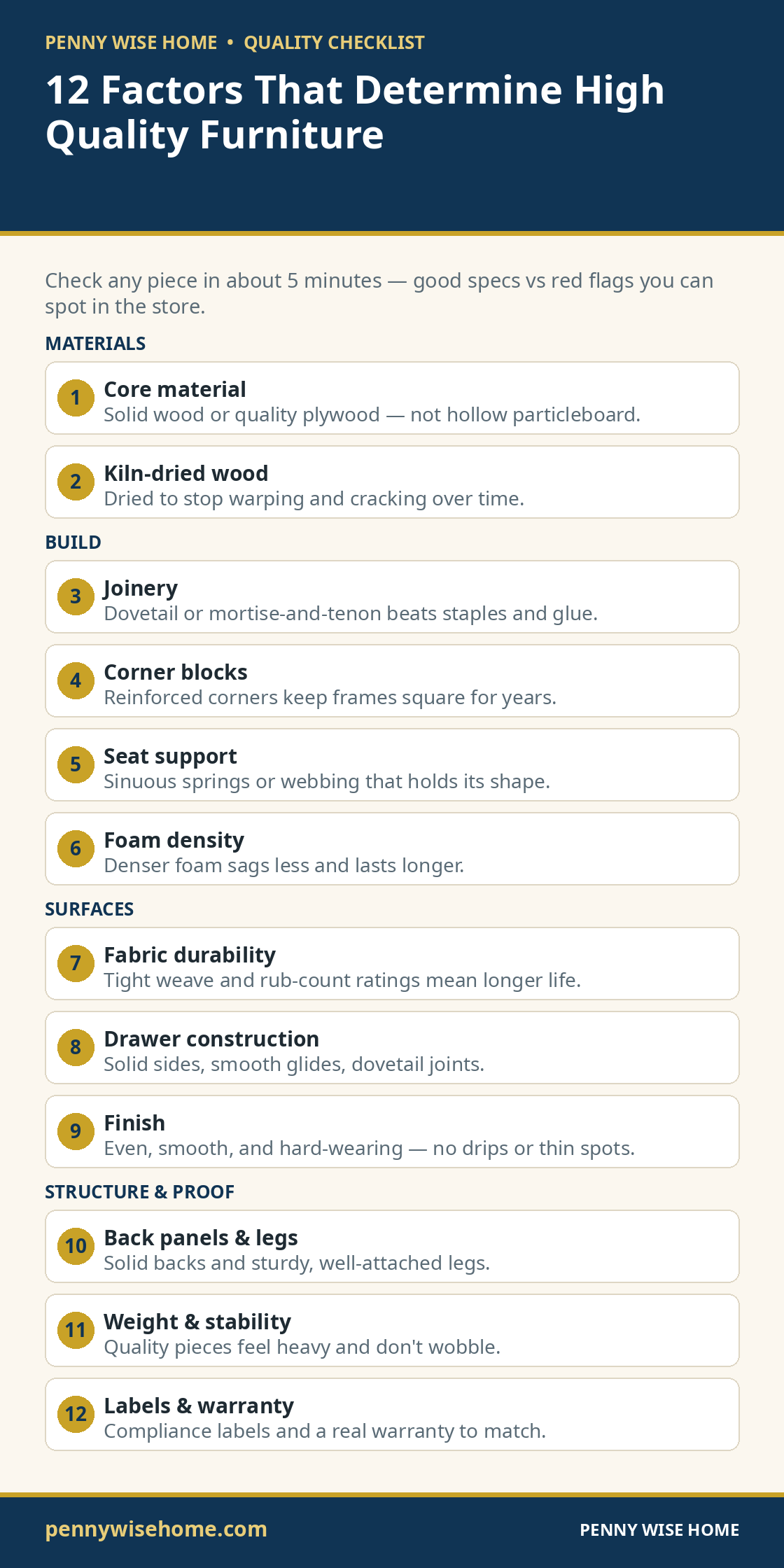
The 12 Factors That Determine High Quality Furniture (Quick Chart)
| # | Factor | High quality looks like | Red flag |
|---|---|---|---|
| 1 | Core material | Solid hardwood or hardwood plywood | Particleboard with laminate |
| 2 | Wood drying | Kiln-dried to about 6–8% moisture | No drying info, visible cracks |
| 3 | Joinery | Dovetail, mortise-and-tenon | Staples, cam locks only |
| 4 | Corner blocks | Glued and screwed | Missing or stapled |
| 5 | Seat support | 8-way hand-tied or heavy sinuous springs | Elastic webbing only |
| 6 | Cushion foam | 1.8+ lb/ft³; HR foam 2.5+ lb/ft³ | Unlisted or very light foam |
| 7 | Fabric | 15,000+ double rubs | No abrasion rating |
| 8 | Drawers | Full-extension metal glides, solid box | Plastic runners, stapled box |
| 9 | Finish | Multi-coat, smooth, sealed underneath | Paper laminate, raw undersides |
| 10 | Back panels & legs | Inset panels, legs joined to frame | Nailed hardboard, screw-on legs |
| 11 | Weight & stability | Heavy, no racking | Light, sways when pushed |
| 12 | Compliance & warranty | TSCA Title VI label, long frame warranty | No labels, 1-year blanket warranty |
Key takeaway: If a piece fails three or more of these factors, it won’t last — no matter how good it looks.
1. Core Material: The First Factor That Determines Quality
Material is the biggest of the factors that determine high quality furniture. Solid hardwoods like oak, maple, walnut, and cherry are strong and repairable. Hardwood plywood is a solid runner-up — cross-layered sheets resist warping.
Here’s the catch: “wood” on a listing can mean anything. Particleboard and MDF are wood products too.
- Solid wood con: It moves with humidity, so cheap builds can split if not designed for movement.
- Veneer con: Thin veneers can’t be sanded deeply, so heavy scratches are permanent.
Who Should Skip Solid Wood: Frequent movers in walk-ups. The weight adds up fast.
2. Kiln-Dried Wood
Fresh lumber holds a lot of water. Good makers kiln-dry it to around 6–8% moisture so it matches indoor air and won’t crack, twist, or loosen joints later.
Ask the seller. A quality maker knows the answer.
3. Joinery: How Pieces Connect
The truth is, joints fail before wood does. Strong joints spread stress across large glued surfaces.
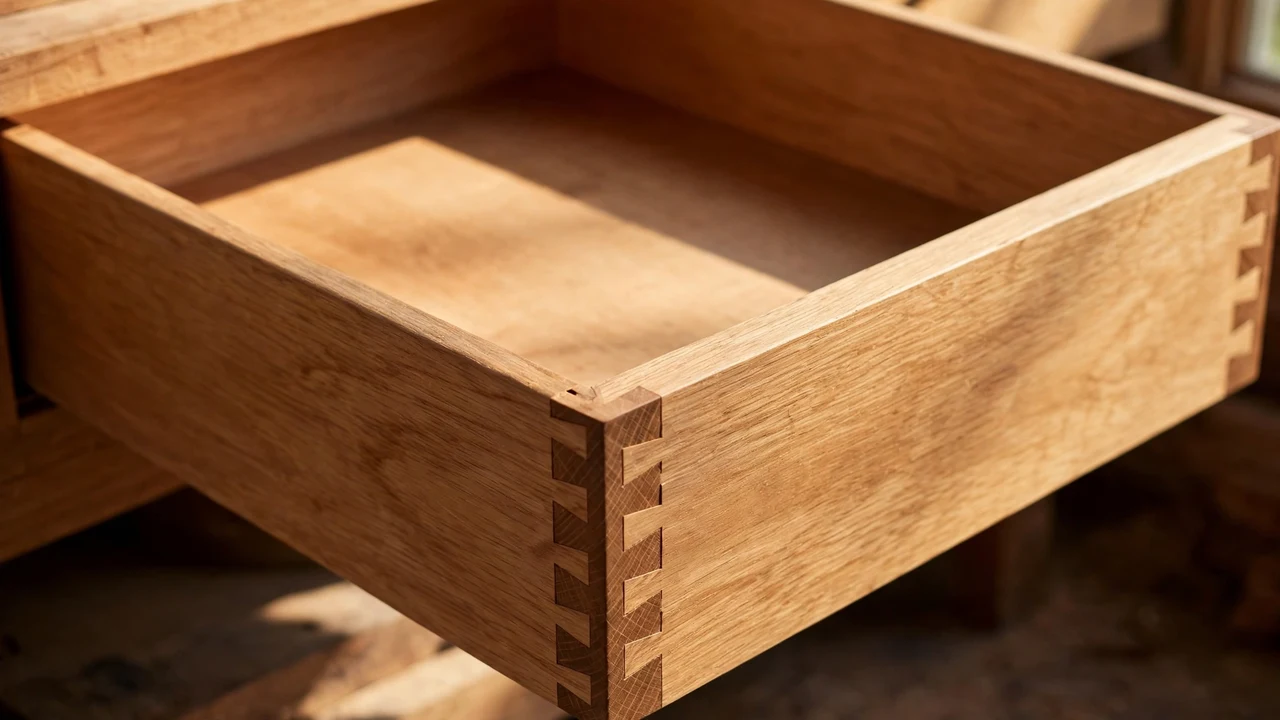
- Dovetail: Interlocking “tails” on drawer corners. The gold standard.
- Mortise-and-tenon: A tongue fits into a slot. Common on quality tables and chairs.
- Dowels with glue: Acceptable when well fitted.
- Staples and cam locks: Budget methods that loosen over time.
4. Corner Blocks
Flip a chair or sofa over. Triangular wood blocks at the inside corners stiffen the frame.
Glued and screwed blocks are a sign of quality. Stapled-only blocks loosen within a few years.
5. Seat Support Systems
Now, you might be wondering which spring system is best. Here’s the honest breakdown.
- 8-way hand-tied: Coils tied in eight directions. Premium and comfortable. Cons: expensive, and poor tying can sag unevenly.
- Sinuous (S-springs): Zigzag wire across the frame. Cons: thin-gauge versions sag, and they can feel firm at the edges.
- Webbing only: Elastic bands. Cons: stretches out quickly under daily use.
Who Should Skip Webbing-Only Sofas: Anyone using the sofa daily or buying for a heavy-use family room.
6. Cushion Foam Density
Foam density (pounds per cubic foot) predicts how long cushions keep their shape. Around 1.8 lb/ft³ is a reasonable floor for seat cushions. High-resilience (HR) foam at 2.5 lb/ft³ or higher bounces back longer.
Picture this: two sofas feel identical in the showroom. After two years, the low-density one has a butt-shaped dent on your favorite seat. The other doesn’t.
7. Fabric Durability
Upholstery fabrics get rated by abrasion tests. For everyday family use, 15,000+ double rubs on the Wyzenbeek test is a common heavy-duty residential benchmark. Tight weaves and performance fabrics also resist pilling and pet claws — see our pet-friendly home guide.
8. Drawer Construction
Drawers get opened thousands of times a year. Quality signs:
- Full-extension metal ball-bearing glides
- Solid wood drawer sides with dovetails
- A drawer bottom set into grooves, not stapled on
- Drawer stops so it can’t fall out
Need a well-built compact option? Check our best small dressers for small bedrooms.
9. Finish Quality
A good finish protects the wood from spills, heat, and UV. Run your hand across it — it should feel smooth and even.
Check underneath too. Quality makers seal hidden surfaces so the wood absorbs moisture evenly and doesn’t warp.
10. Back Panels and Legs
On the flip side, small details expose shortcuts. Thin hardboard backs nailed onto dressers let the case rack.
Screw-in legs on sofas can loosen and snap. Look for legs that are part of the frame or bolted through a solid block.
11. Weight and Stability
Heavier usually means denser materials. Push gently on the top corner of a bookcase or dresser.
If it sways side to side, the joinery or back panel is weak. Anchor tall pieces anyway — the CPSC’s Anchor It! guide explains how.
12. Compliance Labels and Warranty
That brings us to the factor most shoppers skip. Composite wood sold in the U.S. must meet EPA TSCA Title VI formaldehyde standards, with limits of 0.05 ppm for hardwood plywood, 0.09 ppm for particleboard, and 0.11 ppm for MDF. A visible compliance label shows a legit supply chain.
Look for extra certifications too:
- GREENGUARD Gold for low chemical emissions
- FSC for responsibly sourced wood
Finally, read the warranty. Long frame coverage and clear terms signal a maker who expects the piece to last.
Where to Spend vs Save Using These Quality Factors
The truth is, not every piece needs to pass all 12 factors. Match the quality bar to how hard the piece works.
| Piece | Quality bar | Factors to prioritize |
|---|---|---|
| Sofa | High | Frame, springs, foam, fabric |
| Dining chairs | High | Joinery, corner blocks, weight |
| Dresser | Medium-high | Drawers, back panel, stability |
| Bed frame | Medium | Slat support, joinery |
| Bookshelf, side tables | Low | Stability, anchoring |
Your 5-Minute In-Store Quality Check
- Read the materials tag.
- Pull out a drawer and look at the corners.
- Flip a chair and check the corner blocks.
- Lift one end of the sofa and watch for twisting.
- Unzip a cushion and look at the foam.
- Push the top of tall pieces for racking.
- Ask about warranty terms.
Before you shop, check our list of things renters waste money on, and compare budget brands in our IKEA vs Wayfair sofas guide.
Bottom Line
The factors that determine high quality furniture come down to what’s inside: solid materials, dried wood, strong joints, real support systems, and honest labels. Use the 12-factor chart to judge any piece at any price. Buy the best you can afford for sofas, beds, and dressers — and save on the rest.
FAQs
What is the most important factor in furniture quality?
Materials and joinery. Solid hardwood or plywood joined with dovetails or mortise-and-tenon outlasts particleboard held with staples.
How can you tell if furniture is good quality?
Check drawer joints, corner blocks, frame material, cushion foam, weight, and whether the piece sways when pushed.
Is MDF furniture good quality?
It’s mid-range. MDF is smooth and stable but heavy, weak against water, and hard to repair.
What does kiln-dried mean in furniture?
The wood was dried in a controlled oven to a low moisture level, which helps prevent cracking and warping.
What foam density is best for sofa cushions?
About 1.8 lb/ft³ is a reasonable minimum. High-resilience foam at 2.5 lb/ft³ or more lasts longer.