A cramped bedroom affects how you sleep, how you start your day, and how relaxed you feel at home. The good news? You don’t need to knock down walls or spend thousands on custom furniture to make your tiny space feel open and airy.
This guide pulls together proven techniques from interior design principles, color psychology, and budget home improvement strategies that designers, professional organizers, and DIY communities consistently recommend for making small bedrooms feel significantly larger. Every method here can be done for under $100 total — and many cost almost nothing.
If you’ve been searching for how to make a small bedroom feel twice without committing to a full renovation, this step-by-step guide will give you a clear plan.
Why Small Bedrooms Feel Cramped (And How Perception Works)
Before diving into solutions, it helps to understand what makes a room feel small in the first place. Three main factors consistently come up in interior design literature:
- Visual clutter — The more objects competing for attention, the smaller a room feels. Research from the Princeton Neuroscience Institute has shown that visual clutter directly competes for our attention and creates a sense of mental overwhelm.
- Light levels — Dark spaces appear to close in. Bright, well-lit rooms feel expansive.
- Sightlines — When the eye can travel uninterrupted from one end of a room to another (especially toward windows or mirrors), the brain perceives more space.
Most of the tiny bedroom hacks in this guide work because they manipulate one or more of these factors. You’re not changing the square footage — you’re changing how your brain processes the room.
Your $100 Budget Breakdown
Here’s a rough framework to keep in mind as we go through each technique. Final costs vary by location and retailer, but this gives you a working baseline:
| Item | Estimated Cost |
| One gallon of light paint | $25–35 |
| Large secondhand mirror | $15–25 |
| Bed risers (set of 4) | $10–15 |
| LED strip lights | $10–15 |
| Sheer curtains + tension rod | $15–20 |
| Storage baskets/bins | $10–15 |
That’s roughly $85–125 if you buy everything new. Sourcing from thrift stores, online marketplaces, or your own closet can keep the total well under $100.
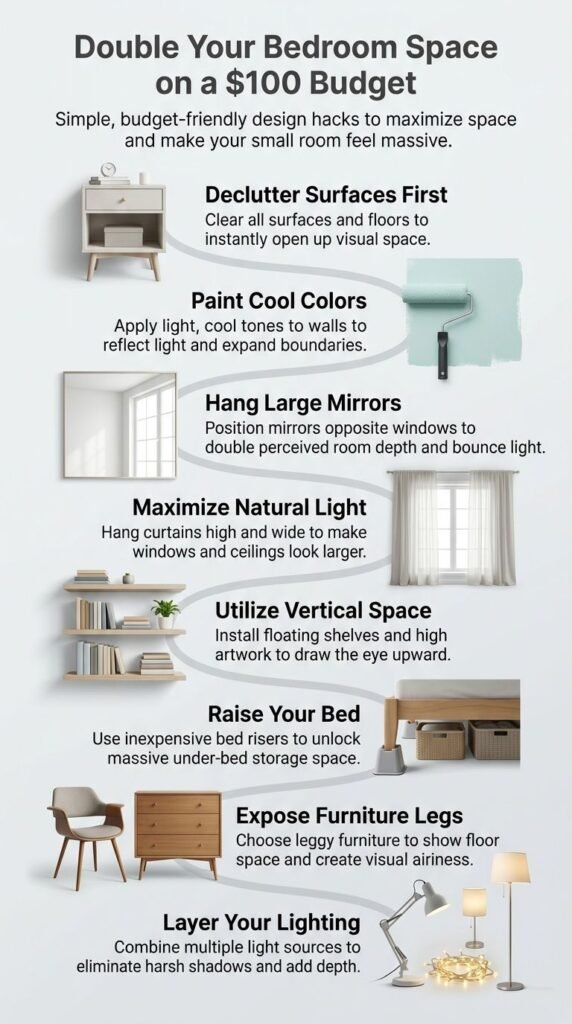
Step 1: Declutter Before You Buy Anything
This is the single most impactful — and most free — change you can make. In a small bedroom, the effect of clutter is magnified because every object takes up a larger percentage of your visual field. If the room doubles as guest space, a budget sleeper sofa is the smart move.
Before spending a single dollar:
- Empty surfaces. Nightstands, dressers, and windowsills should hold only essentials. Aim for three items or fewer per surface.
- Clear the floor. Shoes, laundry baskets, and stray bags all eat visual space and break up sightlines.
- Edit your wall art. A gallery wall of small pieces makes a room feel busier. One large statement piece feels calmer and more expansive.
- Remove furniture you don’t truly need. That extra chair you never sit in? Move it out.
Cost: $0.
Time: 1–3 hours.
Impact: Significant. Most people are surprised at how much bigger their room feels after this step alone.
Step 2: Paint With Light, Cool Colors
Color is one of the most powerful tools for making a small bedroom feel bigger. Light, cool colors — whites, soft grays, pale blues, sage greens — reflect more light than dark or warm tones. This makes walls feel like they’re receding rather than closing in.
A few research-backed tips:
- Stick to one color family for walls, ceiling, and trim. Strong contrast between these surfaces visually chops up the room.
- Consider painting the ceiling the same color as the walls (or just one shade lighter). This blurs the boundary where walls meet ceiling, making the room feel taller.
- Choose a satin or eggshell finish rather than flat. The slight sheen bounces more light.
One gallon of quality paint runs about $25–35 and is more than enough for a standard small bedroom. This is one of the highest-impact small bedroom ideas on a budget.
If you rent and can’t paint, large fabric tapestries or removable peel-and-stick wallpaper in light colors can simulate the effect — though usually at a slightly higher cost.
Step 3: Hang a Large Mirror Strategically
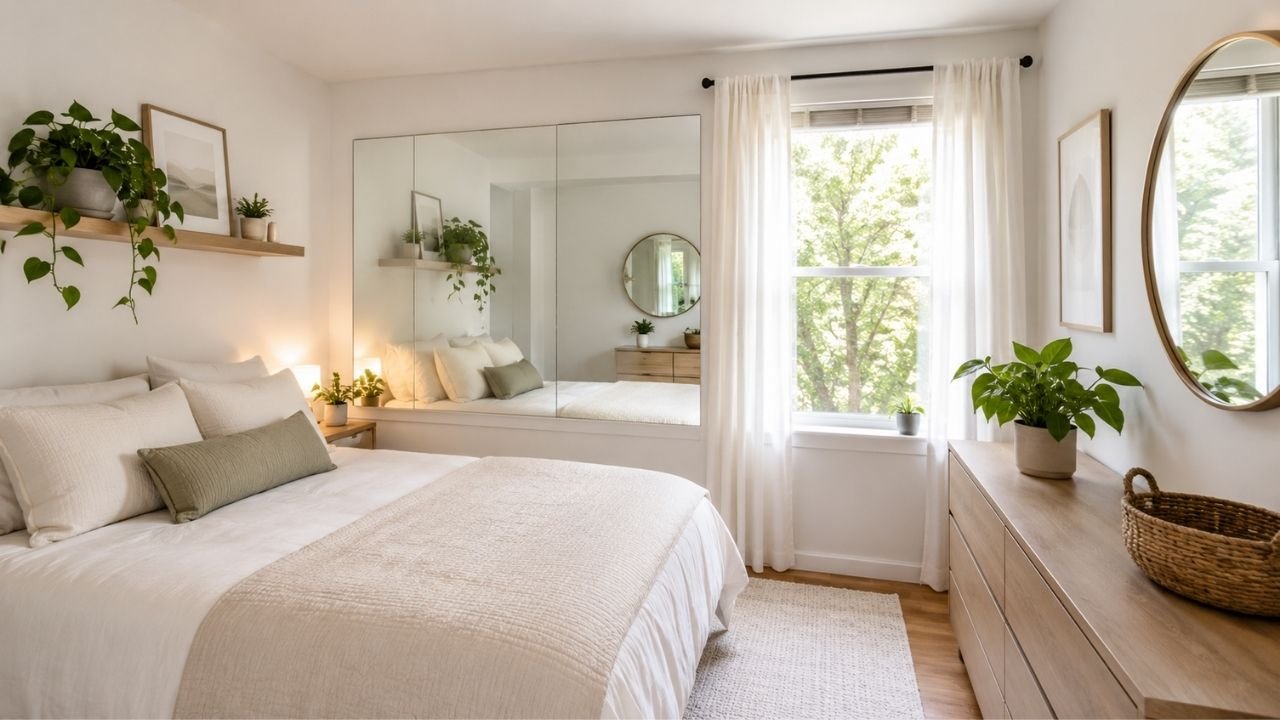
Mirrors are the most-recommended trick in nearly every interior design source, and for good reason. They double the perceived depth of a room, bounce natural light around, and create the illusion of an additional window.
Two key placement rules:
- Place a mirror opposite or adjacent to your window. This reflects natural light deeper into the room.
- Go big rather than small. One large floor mirror or wall mirror has more impact than several small ones. A leaning floor mirror is a popular option because it adds height too.
Where to find affordable large mirrors:
- Thrift stores and Habitat for Humanity ReStores ($10–30)
- Facebook Marketplace and Craigslist (often free if you can pick up)
- Garage sales and estate sales
- IKEA’s budget mirror line (under $25 for full-length)
Budget target: $15–25.
Step 4: Maximize Natural Light
Natural light is the fastest way to make any room feel bigger. If you can see the source of light clearly, the room reads as more open.
Free or near-free changes:
- Pull furniture away from windows so nothing blocks light.
- Clean your windows thoroughly — dust and grime noticeably reduce how much light gets through.
- Trim back any outdoor plants or shrubs covering the glass.
Cheap upgrades:
- Swap heavy curtains for sheer white panels (around $10–15 for a pair from discount retailers).
- Hang curtains high and wide. Mount the rod 4–6 inches above the window frame and extend it 3–6 inches past each side. This makes windows appear larger and ceilings taller.
- A simple tension rod or basic curtain rod from a dollar or discount store runs $5–10.
Total cost: $15–25.
Step 5: Use Vertical Space
When floor space is limited, the answer is up. Drawing the eye upward makes ceilings feel taller and gives the room a sense of openness.
Techniques worth trying:
- Floating shelves above the bed or in unused corners ($10–20 for a basic set).
- Tall, narrow bookcases rather than wide, short ones.
- Wall hooks for bags, hats, and jewelry to keep surfaces clear.
- Curtains hung at ceiling height, even if the window is shorter.
- A single tall vertical piece of art rather than horizontal landscape pieces.
This is one of the most reliable tiny bedroom hacks because it adds storage and visual height without subtracting from the room’s footprint.
Step 6: Raise the Bed for Hidden Storage
In a small bedroom, the bed dominates the room. Making it work harder frees up space everywhere else.
Bed risers ($10–15 for a set of four) lift your bed 3–8 inches off the floor, creating room underneath for:
- Under-bed storage containers
- Out-of-season clothing
- Shoes
- Extra bedding
This alone can eliminate the need for a separate dresser or storage unit, opening up significant floor space. Combined with low-profile under-bed bins ($5–10 each at discount stores), you’ve solved much of your storage problem for under $30.
A bed frame with built-in drawers is even better, but those usually start around $150 — outside our budget.
Step 7: Choose Furniture That Shows Its Legs
A counterintuitive but well-documented design principle: furniture with visible legs makes a room feel bigger than furniture that sits flat on the floor. Why? You can see the floor underneath, which extends the visible floor area and creates a sense of airiness.
You don’t have to buy new furniture for this. If you have a skirted chair or a heavy dresser pushed to the floor:
- Add inexpensive furniture legs from a hardware store ($5–15 for a set of four).
- Remove bed dust ruffles or skirts that hide the floor underneath.
This is one of the easiest small bedroom ideas on a budget because it costs almost nothing but transforms how the room reads.
Step 8: Add Layered Lighting
Single overhead lights cast harsh shadows and emphasize how small a room is. Layered lighting — multiple light sources at different heights — creates depth and warmth, making the space feel more expansive.
For under $30, you can add:
- LED strip lights ($10–15) hidden behind the headboard or under floating shelves. These create a soft glow that makes walls feel further apart.
- A small bedside lamp if you don’t already have one. Thrift stores routinely have these for $5–10.
- A clip-on reading light for the headboard ($5–10).
The general rule is to have at least three light sources in the room: overhead (or substitute), bedside, and accent. Warmer color temperatures (2700K–3000K) tend to feel cozier without making the space feel smaller. Cooler temperatures (4000K+) can make a room feel more open but less restful at bedtime.
Step 9: Use One Large Rug, Not Several Small Ones
This is a small but powerful trick. Several small rugs visually fragment the floor, which makes a room feel choppy and smaller. One larger rug — even if it doesn’t fill the whole room — creates a single, calm visual zone.
If you already own a small rug, consider moving it to another room rather than buying a new one. If you do need a budget rug:
- Discount retailers like HomeGoods, Marshall’s, or TJ Maxx routinely have 5×7 rugs for $30–50.
- Skip ornate patterns; solid colors or subtle textures work better in small spaces.
This step is optional within our $100 budget — but worth noting if you have flexibility.
Step 10: Limit Your Color Palette and Patterns
Small rooms generally feel calmer (and bigger) with a restricted palette: two or three colors maximum, including your wall color. Loud patterns and multiple competing colors make a room feel busy and small.
Practical applications:
- Bedding in solid, light colors (white, cream, light gray, soft pastels)
- Throw pillows in coordinating tones, not high-contrast ones
- Wall art that uses colors already in the room
You don’t need to buy anything new — just edit what you already have. Store away the busy patterned pillow or the bright red throw blanket and see how the room feels after a week.
A Sample $100 Plan You Can Follow This Weekend
Here’s one possible breakdown if you’re starting from scratch:
| Purchase | Cost |
| One gallon of light paint (eggshell white or soft gray) | $30 |
| Used full-length mirror from Facebook Marketplace | $15 |
| Set of 4 bed risers (3–4 inch) | $12 |
| LED strip lights (16ft, warm white) | $12 |
| Sheer white curtain panels + tension rod | $18 |
| Two under-bed storage bins | $10 |
| Total | $97 |
This is a weekend project. Painting takes the longest — figure on Saturday for prep and painting, and Sunday for everything else. The right furniture matters most. See the space-saving furniture for studio apartments.
Common Mistakes to Avoid
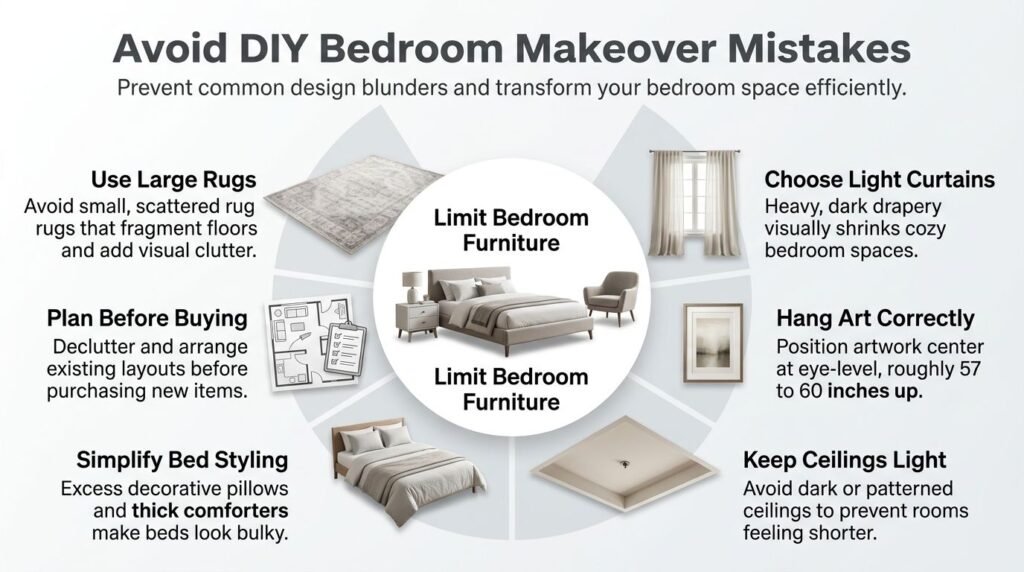
A few mistakes come up over and over in DIY bedroom transformations:
- Buying too much furniture. A small bedroom needs a bed, one small dresser or nightstand, and maybe a chair. That’s it.
- Choosing dark or heavy curtains. Even one pair of dark curtains can shrink a room visually.
- Using multiple small rugs. They fragment the floor and add visual clutter.
- Hanging art too high or too low. Art should be hung so the center is roughly at eye level — about 57–60 inches from the floor.
- Forgetting the ceiling. A dark or patterned ceiling makes a room feel shorter. Keep it light.
- Overloading the bed. Too many decorative pillows and a thick comforter make the bed (and room) feel bulky.
- Buying first, planning second. Always declutter and rearrange before spending money. You may discover you don’t need half of what you planned to buy.
Final Thoughts
Making a small bedroom feel twice as big isn’t about magic or expensive renovations. It’s about understanding a few core design principles — light, sightlines, color, and clutter — and applying them consistently.
The techniques in this guide come from common, well-documented design wisdom and DIY community experience. Some will have a bigger impact in your specific room than others; that’s normal. Start with the free changes (decluttering, rearranging, cleaning windows) and build from there.
If your budget is tighter than $100, focus on these three steps first:
- Declutter ruthlessly (free)
- Hang one large mirror (under $25)
- Add sheer curtains and hang them high and wide (under $20)
Those three alone will noticeably change how your small bedroom feels — and they’re a solid starting point for anyone working through small bedroom ideas on a budget for the first time.
The rest of the steps build on that foundation. Work through them at your own pace, and remember: a small bedroom doesn’t have to feel small.
About The Author