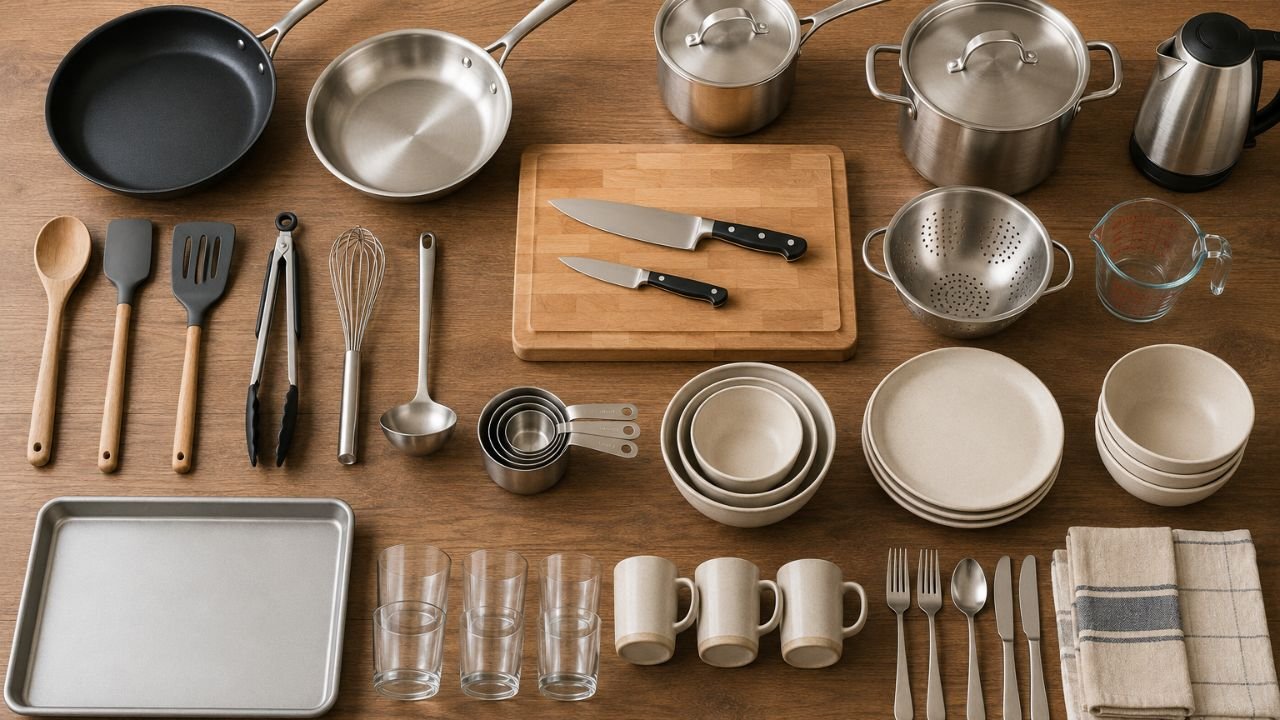
Walk into any TikTok or Instagram kitchen tour, and you’d think you needed a marble countertop full of pastel appliances just to make scrambled eggs. The viral “first apartment kitchen essentials” lists circulating online often run 80, 100, even 150 items long — and most of them are designed to sell you stuff, not to feed you.
Here’s the truth: people have been cooking incredible meals for centuries with a small handful of tools. Your first kitchen needs to be functional, not Pinterest-perfect. The right starter kit for an apartment isn’t a curated aesthetic — it’s a tight, versatile set of pieces that handle 95% of the cooking you’ll actually do.
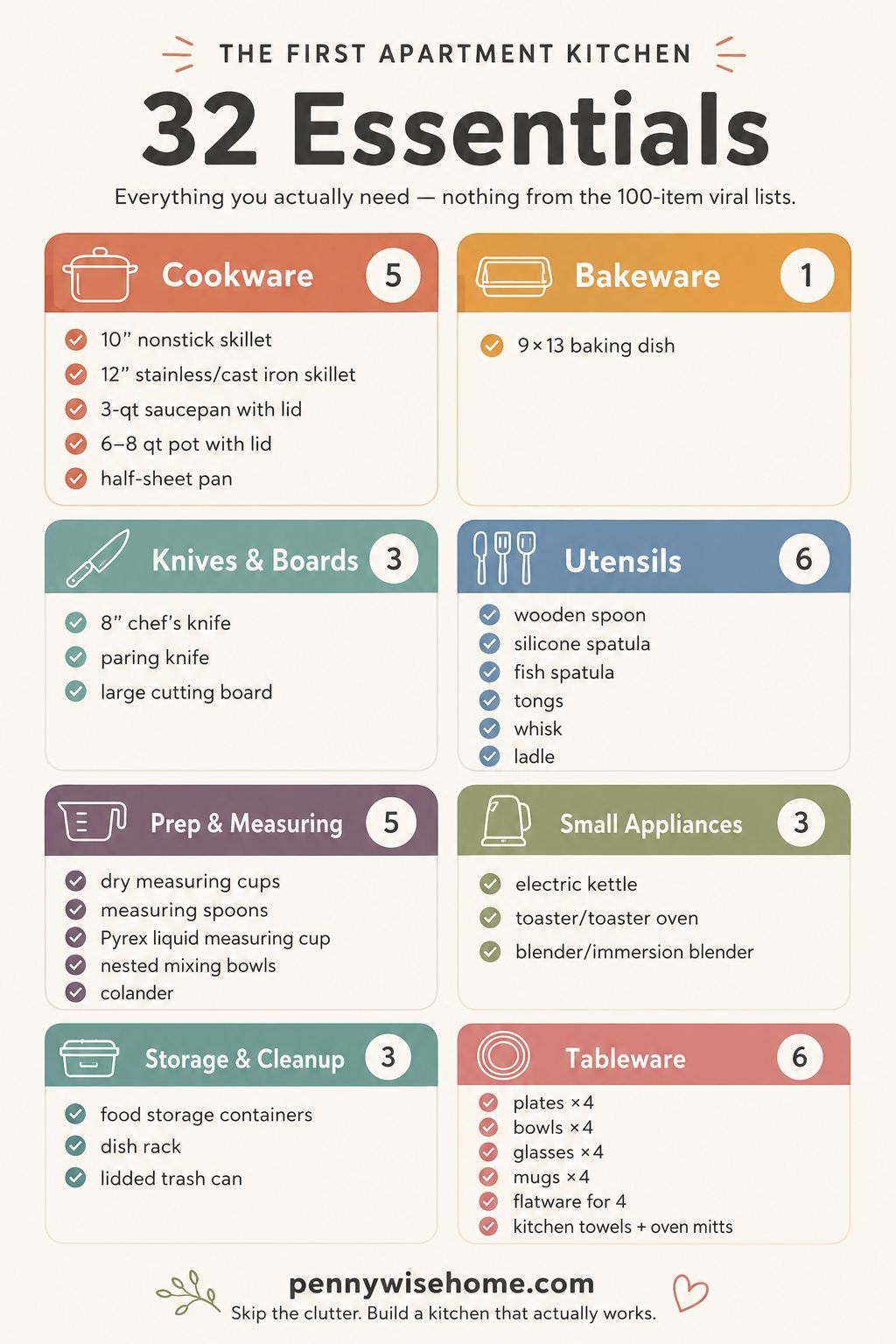
This guide breaks down the 32 must-have kitchen items for a first apartment, organized by category, with notes on what to look for, what to skip, and where to save versus splurge. At the end, we’ll cover the most overhyped items from viral lists so you don’t waste your budget on gadgets that will live in a drawer untouched.
This is research-based, not influencer-driven. Everything here earns its space.
How We Built The First Apartment Kitchen Essentials List
A genuine first apartment kitchen essentials list has to clear three bars:
- Versatility — Does this tool do multiple jobs, or just one?
- Frequency — Will you reach for it weekly, not seasonally?
- Value — Does it justify both its price and the cabinet space it occupies?
If an item fails any of those three tests, it gets cut. That’s how we ended up at 32 — not 132. You can add specialty items as your cooking habits evolve, but everything below is something a working kitchen genuinely needs. Moving in soon? Don’t miss the complete first apartment checklist.
Cookware: The Foundation (Items 1–5)
Cookware is where most beginners overspend or overbuy. You don’t need a 12-piece matching set. You need five honest pans that cover stovetop and oven work.
1. 10-inch Nonstick Skillet
The single most-used pan in any apartment kitchen. Eggs, pancakes, quesadillas, delicate fish, stir-fries for one or two — all easier in nonstick. Don’t overspend here; nonstick coatings degrade in 3–5 years regardless of price. A $30–$50 mid-range pan from brands like Tramontina or T-fal performs as well as $200 premium options. Replace it when it scratches.
2. 12-inch Stainless Steel or Cast Iron Skillet
For searing, browning, and oven-finishing dishes. Stainless steel is more versatile and easier to maintain; cast iron is heavier, requires seasoning, but lasts forever and adds iron to your food. Either works — pick the one matching your strength and patience.
3. Medium Saucepan (2–3 Quart) With Lid
The workhorse for rice, pasta sauce, soup for two, oatmeal, boiled eggs, and reheating. A 3-quart is the sweet spot for one to two people.
4. Large Pot or Stockpot (6–8 Quart) With Lid
For pasta, stocks, chili, soup batches, and boiling corn. If you have to pick one size, 6-quart hits the apartment cooking range without taking up an entire cabinet.
5. Half-Sheet Baking Pan
A flat aluminum sheet pan is the unsung hero of small-kitchen cooking. Roast vegetables, bake cookies, sheet-pan dinners, reheat pizza, line-and-bake fish. Buy two if you bake even occasionally — they’re cheap and stack flat.
Bakeware: Just One You Actually Need (Item 6)
6. 9×13 Baking Dish
Lasagna, casseroles, brownies, baked pasta, roasted chicken thighs — the 9×13 dish does the work of five different baking pans. Glass (Pyrex) or ceramic both work; glass lets you see browning from the side. Skip the muffin tin, loaf pan, and bundt pan until you have a specific reason to bake those things.
Knives and Cutting Boards (Items 7–9)
If you cut one corner in your kitchen budget, don’t cut it here. Dull knives are dangerous and slow.
7. 8-inch Chef’s Knife
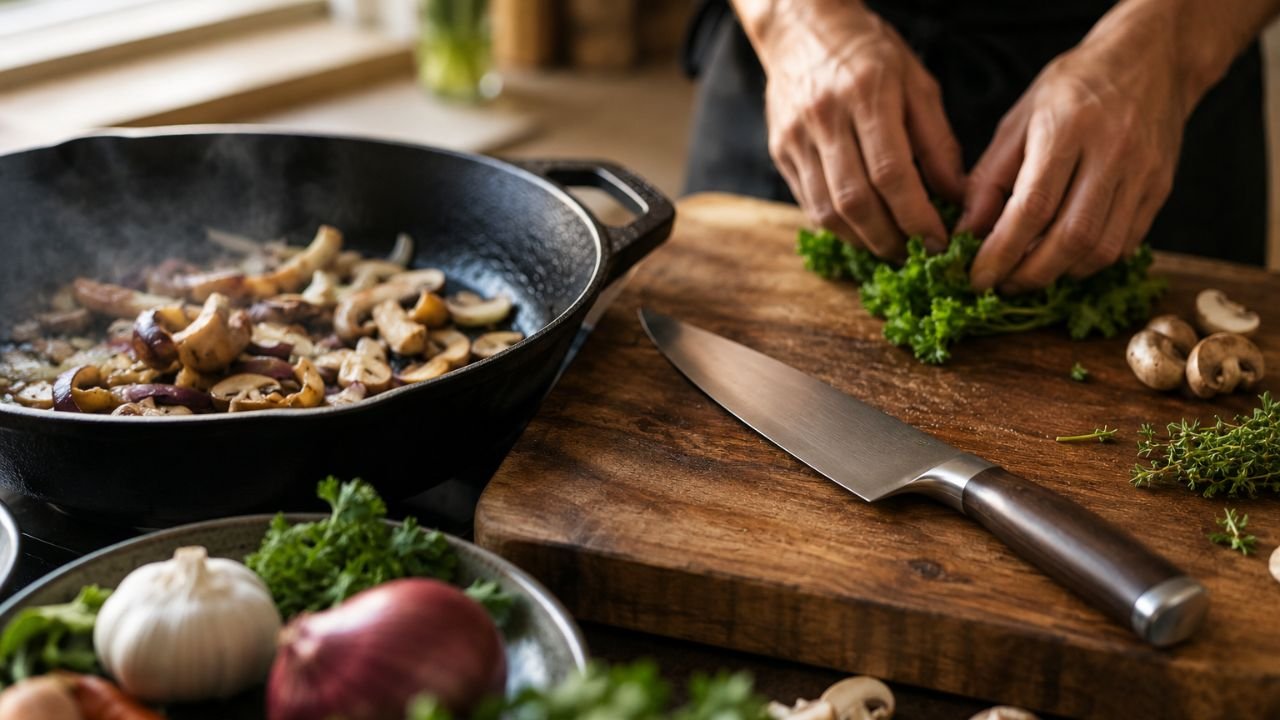
This single knife handles roughly 90% of all kitchen cutting tasks. You don’t need a 15-piece block set. A solid mid-range chef’s knife from Victorinox, Mercer, or Wüsthof Pro (all under $50) outperforms most $200 designer knives for a beginner. Sharpness matters more than brand prestige — and a basic honing rod or $10 pull-through sharpener keeps it in shape.
8. Paring Knife
For the small jobs the chef’s knife is too big for: peeling, hulling, trimming, deveining shrimp. A $10 paring knife is fine.
9. Large Cutting Board
Bigger than you think you need. A 15×20-inch wood or plastic board gives you room to prep without ingredients spilling onto the counter. Wood is gentler on knife edges; plastic is dishwasher-safe. Have at least one — two if you handle raw meat regularly, since color-coding helps avoid cross-contamination.
Cooking Utensils (Items 10–15)
The drawer-fillers. These are the items that make actual cooking possible — and the category where viral lists get most carried away.
10. Wooden Spoon
Stirs, scrapes, doesn’t scratch nonstick, doesn’t melt, doesn’t conduct heat. A single sturdy one is enough.
11. Silicone Spatula (Heat-Resistant)
For scraping bowls, folding batters, and stirring sauces in nonstick pans. Choose silicone rated to at least 450°F so you can use it on the stove without melting the head.
12. Fish Spatula or Metal Turner
A thin, slotted, slightly flexible metal spatula is the best all-purpose flipper for eggs, pancakes, burgers, and fish. The name “fish spatula” undersells how useful it is in every kitchen.
13. Tongs (12-inch)
Locking, spring-loaded kitchen tongs are essentially an extra hand. Flip meat, turn vegetables, toss pasta, plate salad, serve. A 12-inch length keeps your hand out of the heat.
14. Whisk
A medium balloon whisk handles eggs, dressings, gravies, batters, and emulsifying everything. One is enough.
15. Ladle
For soup, stew, chili, sauce, and batter portioning. A 4–6 ounce ladle is the typical apartment size.
Prep and Measuring Tools (Items 16–20)
16. Dry Measuring Cups (Set)
A nested set of metal cups (1, ½, ⅓, ¼) lasts forever and is essential for baking. Plastic works but warps if it sits too close to heat.
17. Measuring Spoons (Set)
Same nested logic. Get one set and you’re done.
18. Liquid Measuring Cup (Pyrex)
The 2-cup glass measuring cup with a pour spout is non-negotiable. You’ll use it for liquids, melting butter in the microwave, mixing dressings, and as an emergency mixing vessel. Pyrex is cheap and nearly indestructible.
19. Mixing Bowls (Nested Set of 3)
A small, medium, and large nested set. Stainless steel is lightweight and durable; glass is heavier but microwave-safe. Either works.
20. Colander or Strainer
For draining pasta, rinsing vegetables, washing rice. A medium 5-quart colander handles most jobs. A fine-mesh strainer is also useful, but if you’re starting out, the colander goes first.
Small Appliances (Items 21–23)
This is where lists explode and budgets die. You actually need three small appliances in a starter apartment kitchen. Maybe.
21. Electric Kettle
Boils water in 90 seconds for tea, coffee, instant noodles, oatmeal, and pasta starts. An electric kettle saves real time over stovetop boiling and uses less energy. $30 buys a great one.
22. Toaster or Toaster Oven
A two-slice toaster is fine. A small toaster oven is more versatile — it reheats pizza, makes melts, toasts bagels, broils a single piece of fish, and replaces a full oven for small jobs. If counter space is tight, pick one. The toaster oven is the more powerful choice for one person.
23. Blender or Immersion Blender
For smoothies, soups, sauces, dressings, and pesto. An immersion blender is cheaper, takes up less space, and goes directly into a pot. A regular countertop blender is better for frozen smoothies and bigger batches. Either works — don’t buy both on day one.
Storage and Cleanup (Items 24–26)
24. Food Storage Containers
A modest set of glass or plastic containers with matching lids for leftovers and meal prep. Glass is preferred — doesn’t stain, doesn’t absorb odors, microwave-safe, oven-safe. Pyrex sets in the $30–$40 range are excellent. Avoid mismatched takeout containers, which never have lids when you need them.
25. Dish Rack
A simple over-the-sink or counter dish rack with a drip tray. Crucial for apartments without dishwashers. Look for one that folds or rolls up if counter space is limited.
26. Trash Can With Lid
Often forgotten until day three of cooking. A lidded can controls odors. 13-gallon is the standard apartment size. Pedal-operated if budget allows — hands-free matters when your hands are covered in raw chicken.
Tableware and Service (Items 27–32)
You can survive on disposable plates for a week. You can’t live that way long-term. Set up your basic table service from day one.
27. Dinner Plates (Set of 4)
Stoneware or porcelain in a plain color. Sets of four are right for one or two people — enough to have guests over, not so many that they crowd a cabinet. IKEA, Target, and Crate & Barrel outlets stock $20–$40 sets that hold up.
28. Bowls (Set of 4)
Both for cereal and soup. Roughly 16–22 ounces is the versatile size — big enough for ramen, small enough for ice cream. Match or mix with your plates; nobody judges.
29. Drinking Glasses (Set of 4)
Standard 16-ounce tumblers. Use them for water, juice, iced coffee, cocktails, and as makeshift measuring cups in emergencies. Buy duplicates because they break.
30. Mugs (Set of 4)
Coffee, tea, hot chocolate, soup, microwaved leftovers. Mugs are the most flexible drinking vessel in a small kitchen.
31. Flatware (Set for 4)
A 20-piece basic flatware set — four dinner forks, four knives, four salad forks, four soup spoons, four teaspoons — covers normal eating and entertaining. Stainless steel only. Avoid coated or “rose gold” sets for daily use; the finish chips fast.
32. Kitchen Towels and Oven Mitts
Easy to overlook. Three to four cotton kitchen towels (for drying hands, drying dishes, covering rising dough, wiping counters) plus one pair of heat-resistant oven mitts. Silicone mitts grip better than cotton ones and don’t burn through.
What to Skip From Viral Kitchen Lists
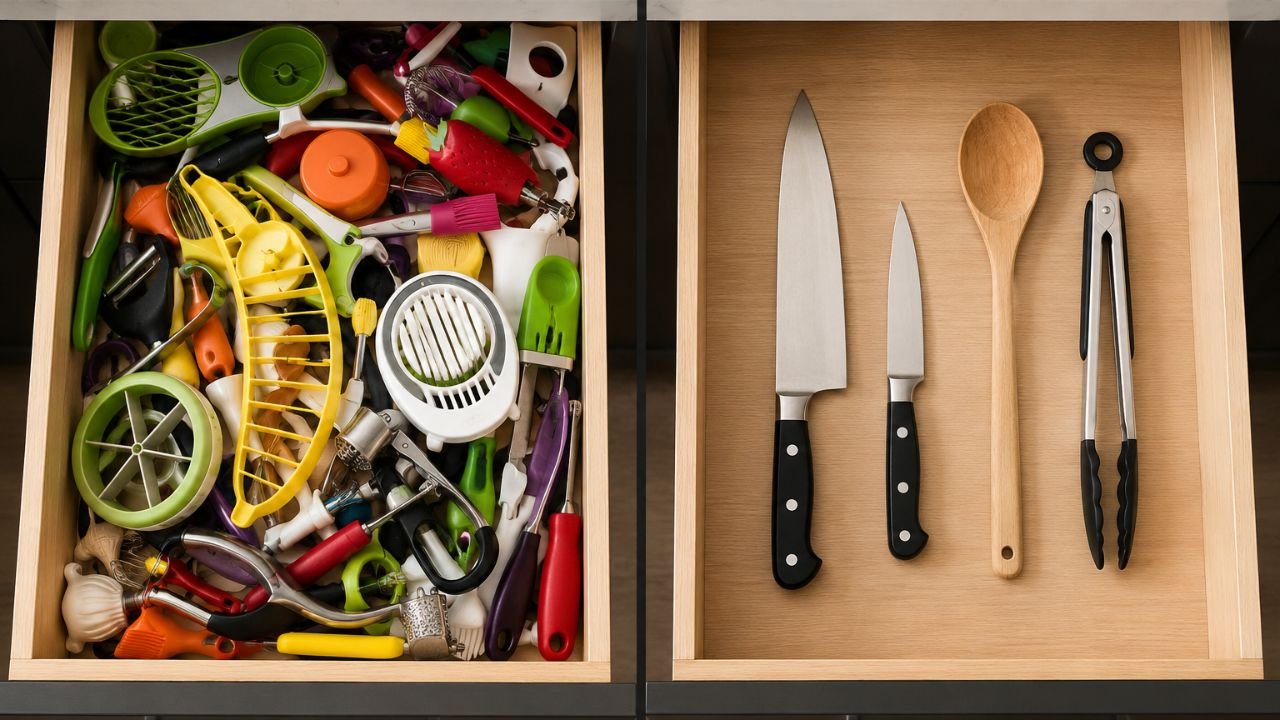
Now the harder part: what to leave on the shelf. The reason viral kitchen lists run so long is that they’re trying to sell you things you don’t need. Here’s what to ignore from the average “100 must-have kitchen items first apartment” post.
Unitaskers (Tools That Do Exactly One Thing)
Avocado slicers, banana slicers, egg separators, apple corers, strawberry hullers, mango pitters, herb scissors, garlic peelers — the entire category exists to take counter space and money. A knife handles every job above. Alton Brown famously hates unitaskers for a reason: they crowd your kitchen with single-use tools when versatile alternatives already exist.
Massive Knife Block Sets
That 15-piece block set on sale for $80 looks like a deal, but you’ll use the chef’s knife, the paring knife, and maybe the kitchen shears. The rest sit there gathering dust and consuming counter space. Two good knives beat fifteen mediocre ones every time.
Pre-Filled Spice Racks
Cute on the counter, terrible in practice. The spices are often stale before you open them, the bottles are tiny, and the rack uses prime real estate. Buy spices individually as recipes call for them — they’ll be fresher and cheaper, especially from bulk bins or international grocery stores.
A Stand Mixer (Unless You Genuinely Bake)
A KitchenAid is gorgeous, expensive ($300+), and takes up massive counter space. If you don’t bake bread, cookies, or cakes at least twice a month, you don’t need one. A hand mixer ($20) handles occasional baking just fine.
An Espresso Machine
Unless you’re already a serious coffee person, a $400 espresso machine becomes a $400 dust collector. A French press, AeroPress, or pour-over setup makes excellent coffee for under $30.
Specialty Appliances You’ll Use Twice
Panini presses, quesadilla makers, electric egg cookers, breakfast sandwich makers, ice cream churners, waffle irons (unless you eat waffles weekly), and — if you have a saucepan — rice cookers. All replicable with tools you already own.
A Mandoline
Cool in theory, dangerous in practice. Mandolines cause more emergency-room kitchen injuries than almost any other tool. Unless you’re slicing potatoes for gratin every week, a sharp chef’s knife is safer and nearly as fast.
Air Fryer or Instant Pot — A Nuanced Take
These aren’t useless, but they aren’t day-one essentials either. An air fryer is a small countertop convection oven; a toaster oven does similar work. An Instant Pot is a pressure cooker plus slow cooker hybrid — genuinely useful if you actually cook beans, stews, and bone broth, less so if you don’t. If you’re not sure you’ll use them weekly, wait six months and see if you miss them. You probably won’t.
“Aesthetic” Cookware Sets
Pastel cookware, viral pans with influencer marketing, matching glass canister sets, expensive knife blocks with bamboo holders — most are designed for photographs, not cooking. Buy function first; if matching aesthetics matter to you, build that out over time as you replace pieces.
A Full Le Creuset or All-Clad Set Day One
Premium cookware is wonderful, but a single $400 Dutch oven shouldn’t be your first purchase. Cook for a year, learn what you actually use, then upgrade the pieces that earn it.
How to Build a Kitchen Starter Kit for an Apartment on a Budget
A few principles that will save you hundreds of dollars across your first year. Once you have the basics, try these renter-friendly kitchen upgrades to make the space feel like yours.
Buy in tiers, not all at once: Start with cookware, knives, basic utensils, and tableware in week one. Add the appliances and storage during month one. Upgrade or replace pieces in year one as you learn what you actually use.
Shop in unglamorous places: Restaurant supply stores carry the same sheet pans, tongs, and mixing bowls professional kitchens use, at half the price of cookware boutiques. Asian and South Asian grocery stores have excellent inexpensive knives, woks, and rice tools. Thrift stores are gold for Pyrex, glassware, mugs, and cast iron — which is essentially indestructible and only gets better with use.
Avoid “starter kits” sold as bundles: Those 23-piece “first apartment” sets on Amazon are usually padded with low-quality unitaskers to inflate the count. You’re paying for plastic that will end up in a drawer or a landfill.
Splurge on the things you touch every day: A chef’s knife, a cutting board, and a sturdy nonstick pan. These are the items that make daily cooking faster and more pleasant. Save on items that get replaced (nonstick pans every few years, plastic utensils) or rarely used (specialty bakeware).
Don’t furnish for hypotheticals: Don’t buy a 12-cup food processor because you might host a dinner party someday. Buy what your real cooking actually needs, and add tools when reality demands it. The kitchen you imagine is almost never the kitchen you use.
Quick Reference: The 32 Essentials at a Glance
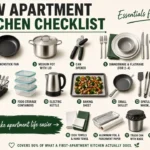
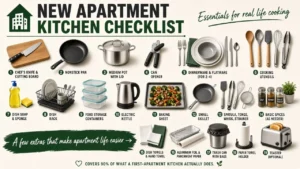
- Cookware: 10-inch nonstick skillet · 12-inch stainless/cast iron skillet · 3-quart saucepan with lid · 6–8 quart pot with lid · half-sheet pan
- Bakeware: 9×13 baking dish
- Knives and boards: 8-inch chef’s knife · paring knife · large cutting board
- Utensils: wooden spoon · silicone spatula · fish spatula · tongs · whisk · ladle
- Prep and measuring: dry measuring cups · measuring spoons · Pyrex liquid measuring cup · nested mixing bowls · colander
- Small appliances: electric kettle · toaster or toaster oven · blender or immersion blender
- Storage and cleanup: food storage containers · dish rack · lidded trash can
- Tableware: plates (4) · bowls (4) · glasses (4) · mugs (4) · flatware for 4 · kitchen towels and oven mitts
Frequently Asked Questions (FAQs)
What’s the absolute minimum kitchen kit if I’m on a tight budget?
If you had to cut the list to a survival minimum, you could cook reasonably well with about 12 items: one nonstick skillet, one saucepan with lid, one sheet pan, a chef’s knife, a cutting board, a wooden spoon, tongs, a measuring cup, a mixing bowl, a colander, a set of four plates, and a set of four utensils. That’s roughly $150–$200 buying mid-range new, or under $80 if you mix thrift store finds with one or two new pieces. Add the rest of the 32 essentials as your budget allows over the following months.
Should I buy a kitchen starter kit bundle or piece things together?
Piece things together, almost always. Pre-packaged “first apartment” kitchen kits look convenient and budget-friendly, but they’re typically padded with low-quality plastic utensils, thin pans that warp on contact with heat, and unitasker gadgets you’ll never use. The same money spent across two or three trips to a thrift store, a restaurant supply shop, and a basic department store produces a kitchen that’s both better-equipped and more durable.
How much should I budget for a complete first apartment kitchen?
Realistically, $300–$500 builds out the full 32-item list if you shop carefully and mix mid-range new pieces with thrift store finds. You can spend $1,000+ if you want premium cookware and nice tableware from day one, but you don’t need to. The savings come from knowing what to splurge on (knives, a versatile skillet, a good cutting board) versus where to save (basic utensils, glassware, food storage). Many of the items hold their value or last decades, so a careful first purchase pays off for years.
Do I really need a cast iron skillet if I have a nonstick?
You don’t strictly need both, but they do different jobs. Nonstick handles delicate proteins and low-heat work — eggs, fish, pancakes. Cast iron (or stainless steel) handles high-heat searing, oven-finishing, and anything that needs a deep brown crust. If your cooking is mostly weeknight quick meals, a nonstick is enough to start. Add the second pan when you start wanting better steak, roasted chicken, or pan sauces.
What about coffee makers — where do they fit?
Coffee setup is genuinely personal and depends entirely on how you drink it. A drip coffee maker, French press, AeroPress, pour-over, or moka pot can all live on under $40. We left a coffee maker off the core 32 because not everyone drinks coffee, but if you do, it absolutely belongs in your kitchen starter kit. Just don’t start with the $400 espresso machine.
Final Thoughts
You can cook genuinely well — better than most people who own three times this much equipment — with the 32 items above. Most experienced home cooks reach a point where they realize their hardest-working tools are a chef’s knife, a cast iron or stainless steel skillet, and a sheet pan, and almost everything else is supporting cast.
The viral lists exist to sell you things. This one exists to feed you. Stick to versatile, well-built basics, learn how to use them, and let your real cooking habits dictate everything you add later. That’s how a kitchen starter kit for an apartment turns into a kitchen that genuinely works — without the clutter, the wasted money, or the regret of a cabinet full of gadgets you never reach for.
Sources & further reading
- Food Thermometers — USDA Food Safety and Inspection Service
- Kitchen Companion: Your Safe Food Handbook (PDF) — USDA FSIS