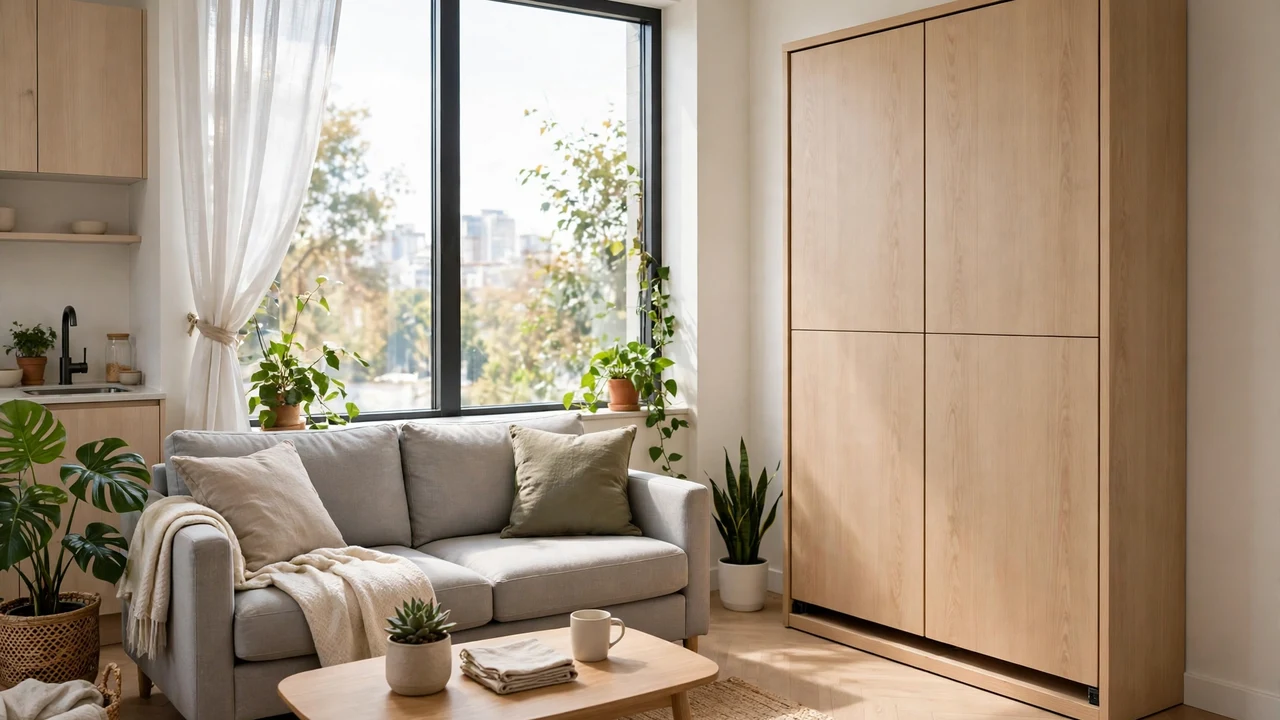
You love Bassett’s custom pieces, but a full sectional and bedroom set swallow your small apartment. The best space-saving furniture alternatives to Bassett Furniture are wall beds, apartment-size sofas, and drop-leaf tables — a queen wall bed alone frees about 30 square feet. Below, you’ll get a swap chart with real dimensions and honest cons for each pick.
Why Look for Space-Saving Alternatives to Bassett Furniture?
To be clear, Bassett isn’t the problem. Bassett Furniture has built furniture since 1902, with custom upholstery and casegoods made at plants in Virginia and North Carolina. It even sells smaller-scale pieces.
Here’s the catch: traditional furniture lines are designed around traditional floor plans. In a 500-square-foot apartment, a standard 88-inch sofa, a 60-inch dresser, and a 72-inch dining table leave you squeezing sideways between pieces.
Space-saving furniture alternatives to Bassett solve that by doing two jobs at once or folding away.
The Swap Chart: Space-Saving Alternatives by Room
| Traditional piece | Typical size | Space-saving swap | Typical size | Space saved |
|---|---|---|---|---|
| Standard 3-seat sofa | 84–90″ W x 38–40″ D | Apartment sofa | 70–78″ W x 32–35″ D | About 3–9 sq ft |
| Queen bed + nightstands | About 70″ W x 90″ L with stands | Queen wall bed | About 18″ deep when closed | Roughly 30+ sq ft of daytime floor |
| Rectangular dining table | 60–72″ L x 36–40″ W | Drop-leaf or gateleg table | About 10–20″ deep folded | 10–15 sq ft |
| Wide 6-drawer dresser | 60″ W x 18–20″ D | Storage bed + tall chest | Under-bed drawers + 30–36″ W chest | About 3–5 sq ft |
| Coffee table + end tables | Multiple pieces | Nesting or lift-top table | One footprint | 3–6 sq ft |
Key takeaway: The wall bed is the single biggest space win. Everything else adds up in smaller chunks.
1. Wall Beds (Murphy Beds): The Biggest Space-Saving Swap
A wall bed folds up into a cabinet, turning your bedroom back into a living room, office, or guest space during the day. Picture this: you’re working from home in a studio, and your bed vanishes behind a cabinet door by 8 a.m.
Before you buy, check:
- Ceiling height: Vertical queen models usually need about 85–90 inches of clearance.
- Open projection: A queen extends roughly 85–90 inches from the wall when down.
- Wall structure: Most must be anchored to studs.
- Con: Installed wall beds are expensive, often costing more than a standard bed and frame combined.
- Con: Mattress thickness is limited, often to about 10–12 inches.
- Con: Anchoring to studs can conflict with lease rules.
Who Should Skip This: Renters who can’t drill into walls and anyone who naps daily — folding the bed gets old fast.
2. Apartment-Size Sofas: Space-Saving Alternatives to Bassett Sectionals
Apartment sofas trim width and depth while keeping three seats. That’s a big deal in rooms where a standard sofa blocks the walkway. Aim to keep about 30–36 inches of clear path around your seating.
Many brands, including Bassett itself, Room & Board, Article, and Burrow, sell compact sofas. Our roundup of small apartment sofas compares options, and if guests stay over, check our sleeper sofas under $1,000.
- Con: Shallow seats can feel cramped for tall people.
- Con: Fewer seat-depth and cushion-fill options than full-size custom lines.
Who Should Skip This: Anyone over about 6’2″ who likes to lie down on the sofa.
3. Modular Sofas: Flexible Space-Saving Alternatives
Modular sofas split into separate pieces. Use two seats in a studio, then add a corner and chaise when you move somewhere bigger.
- Con: Gaps between modules can creep apart on hard floors without connectors.
- Con: Adding pieces later costs more than buying a full sectional up front.
Who Should Skip This: Buyers who want a seamless, tailored look like a custom Bassett sofa.
4. Drop-Leaf and Gateleg Tables
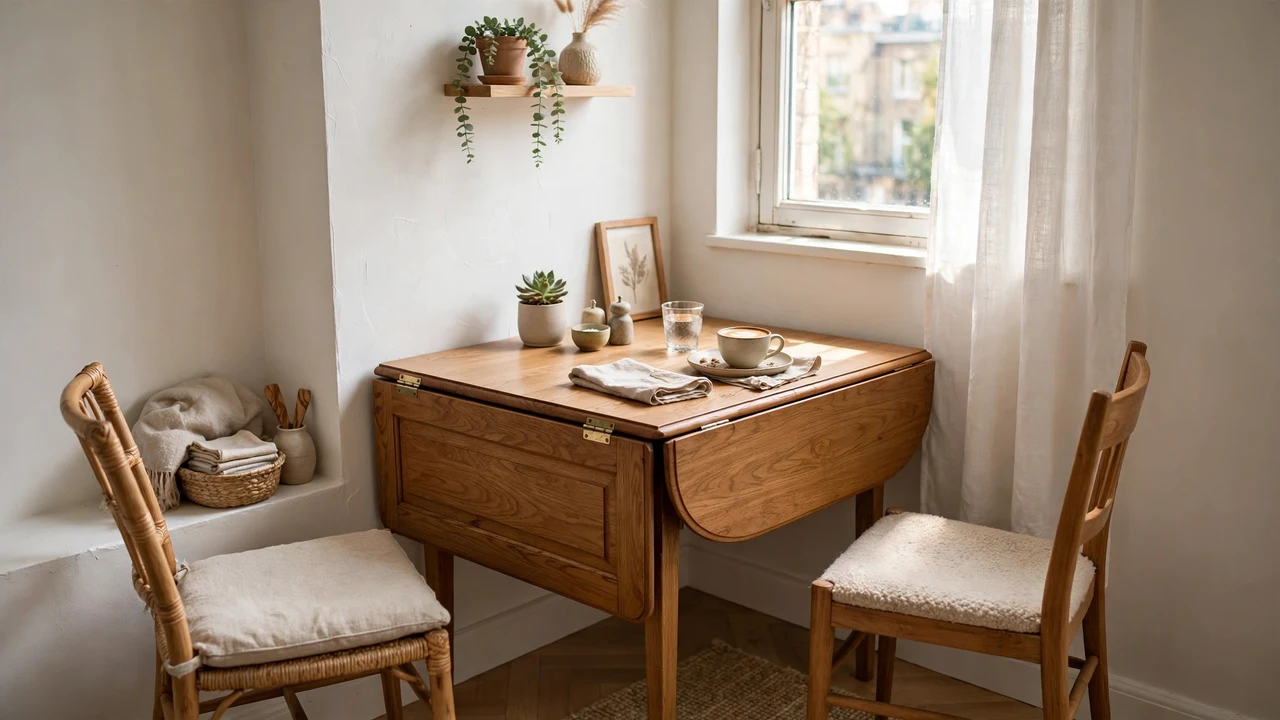
That brings us to the dining room — often the most wasted space in a small home. A gateleg table can fold to about the depth of a console, then open to seat four or six.
- Con: Legs and hinges can wobble on cheap models.
- Con: Leg placement may bump knees when fully open.
Who Should Skip This: Families who eat full meals at the table every night. A small fixed round table may serve you better.
5. Storage Beds Instead of Big Dressers
A storage bed can hold as much as a small dresser, freeing wall space. Pair it with a tall, narrow chest instead of a wide dresser. Our picks for twin XL bed frames with storage and small dressers for small bedrooms show options.
- Con: Side drawers need clear floor space to open, usually 18+ inches.
- Con: Lift-up gas-strut frames are heavy to open and can wear out.
Who Should Skip This: People in rooms where the bed fills wall to wall — drawers won’t open.
6. Wall-Mounted Desks and Nesting Tables
On the flip side, small pieces matter too. A fold-down wall desk can be just a few inches deep when closed. Nesting tables give you three surfaces in one footprint.
- Con: Wall desks have limited weight capacity and small work surfaces.
- Con: Nesting tables are often lightweight and tip if leaned on.
Who Should Skip This: Full-time remote workers with dual monitors. Consider a compact standing desk instead — see our hand-crank vs electric standing desk comparison.
How to Plan Your Space-Saving Swaps
Now, you might be wondering where to start. Follow these steps.
- Draw your floor plan. Measure walls, doors, windows, and outlets.
- Mark walkways. Keep 30–36 inches for main paths.
- Swap the biggest piece first. Usually the bed or the sofa.
- Go vertical. Tall shelves and wall storage beat wide, low pieces. Anchor anything tall — the CPSC’s Anchor It! guide shows how.
- Keep one Bassett-quality piece. Spend on the piece you use most, and choose space-saving alternatives for the rest.
For more layout ideas, see our guides to space-saving furniture for studio apartments and 100 sq ft bedroom ideas. Room & Board’s space-saving ideas are also worth a browse.
Renter-Friendly Notes on Space-Saving Swaps
On the flip side, many space-saving alternatives to Bassett involve walls and anchors — a problem if you rent. Here’s how to stay deposit-safe.
- Freestanding wall beds: Some cabinet-style models stand on their own base. Confirm stability ratings before skipping anchors.
- Ask first: Many landlords allow small anchor holes if you patch them when you leave. Get it in writing.
- Measure the route: Check doorways, hallway turns, and stairwells before ordering any large piece.
- Pick modular: Modular sofas and stackable storage move more easily than one big piece.
Key takeaway: Choose pieces that can move with you. Your next apartment may have a totally different layout.
Bottom Line on Space-Saving Furniture Alternatives to Bassett Furniture
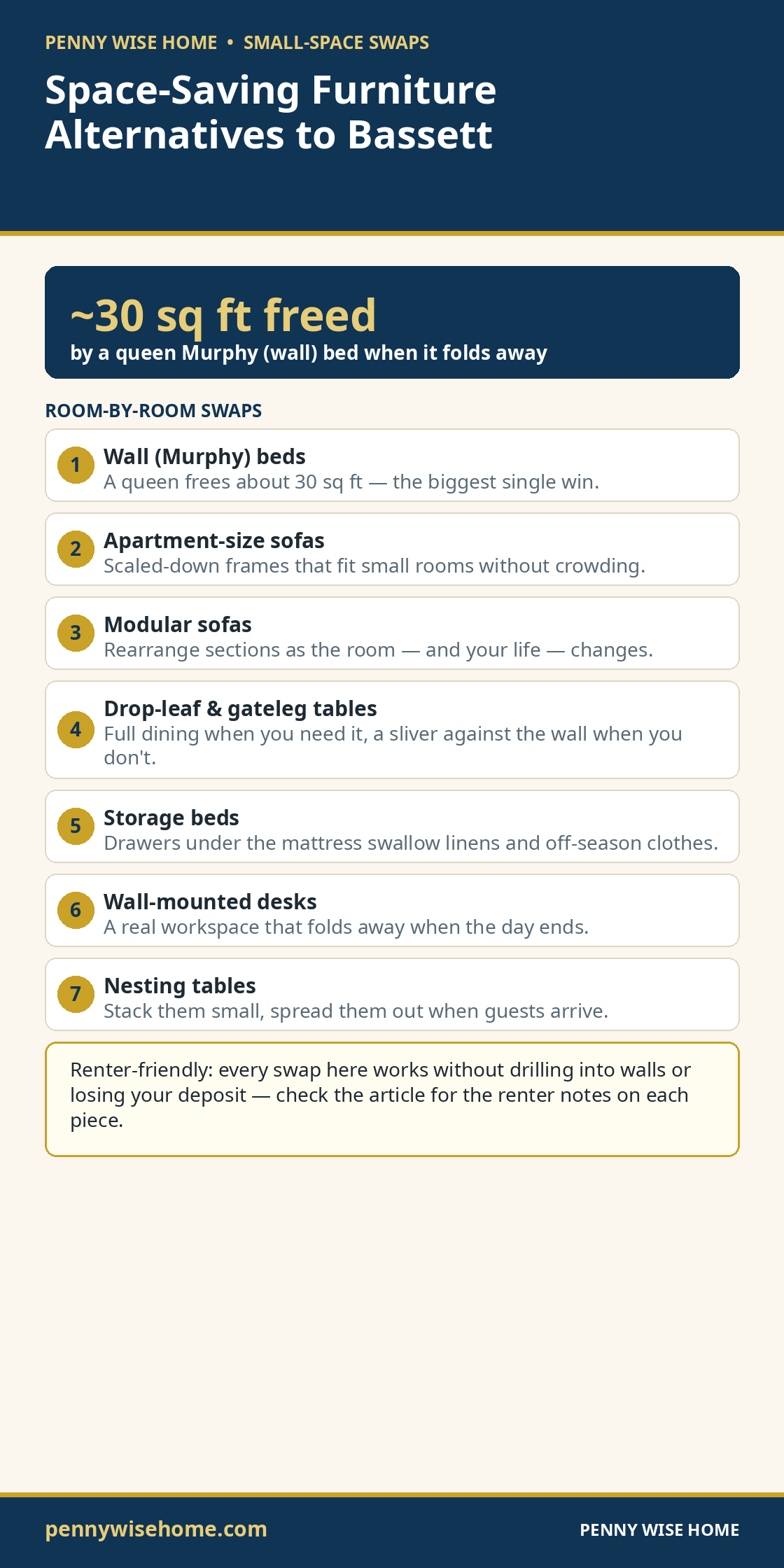
The best space-saving furniture alternatives to Bassett Furniture are a wall bed for the biggest gain, an apartment-size or modular sofa for the living room, and a gateleg table for dining. Keep your quality bar high on the piece you use most. Then let smart, folding, and multi-use pieces do the rest.
FAQs
Does Bassett sell furniture for small spaces?
Yes. Bassett offers smaller-scale sofas and custom sizing on some upholstery, though its line still leans toward traditional room sizes.
What is the most space-saving furniture?
Wall beds save the most floor space, followed by drop-leaf tables and storage beds.
How much ceiling height do you need for a Murphy bed?
A vertical queen wall bed typically needs about 85–90 inches of ceiling clearance. Check the maker’s spec sheet.
What size sofa fits a small apartment?
Most apartment sofas measure about 70–78 inches wide and 32–35 inches deep.
Are modular sofas good for small spaces?
Yes. They let you start small and add pieces later, and modules fit through tight doors and stairs.