Your TV stand’s top is bowing and the edges are chipping, just two years in. The most durable materials for TV stands under daily use are solid hardwood and powder-coated steel — particleboard is the one to avoid. Below, you’ll find a ranked durability chart, honest cons for each material, and the anchor fix that stops tip-overs.
Most Durable Materials for TV Stands: The Ranked Chart
Daily use means more than holding a TV. It means kids leaning on it, game consoles running hot, drinks set down, and cables yanked out of the back.
| Rank | Material | Sag resistance | Moisture resistance | Scratch repair | Typical lifespan |
|---|---|---|---|---|---|
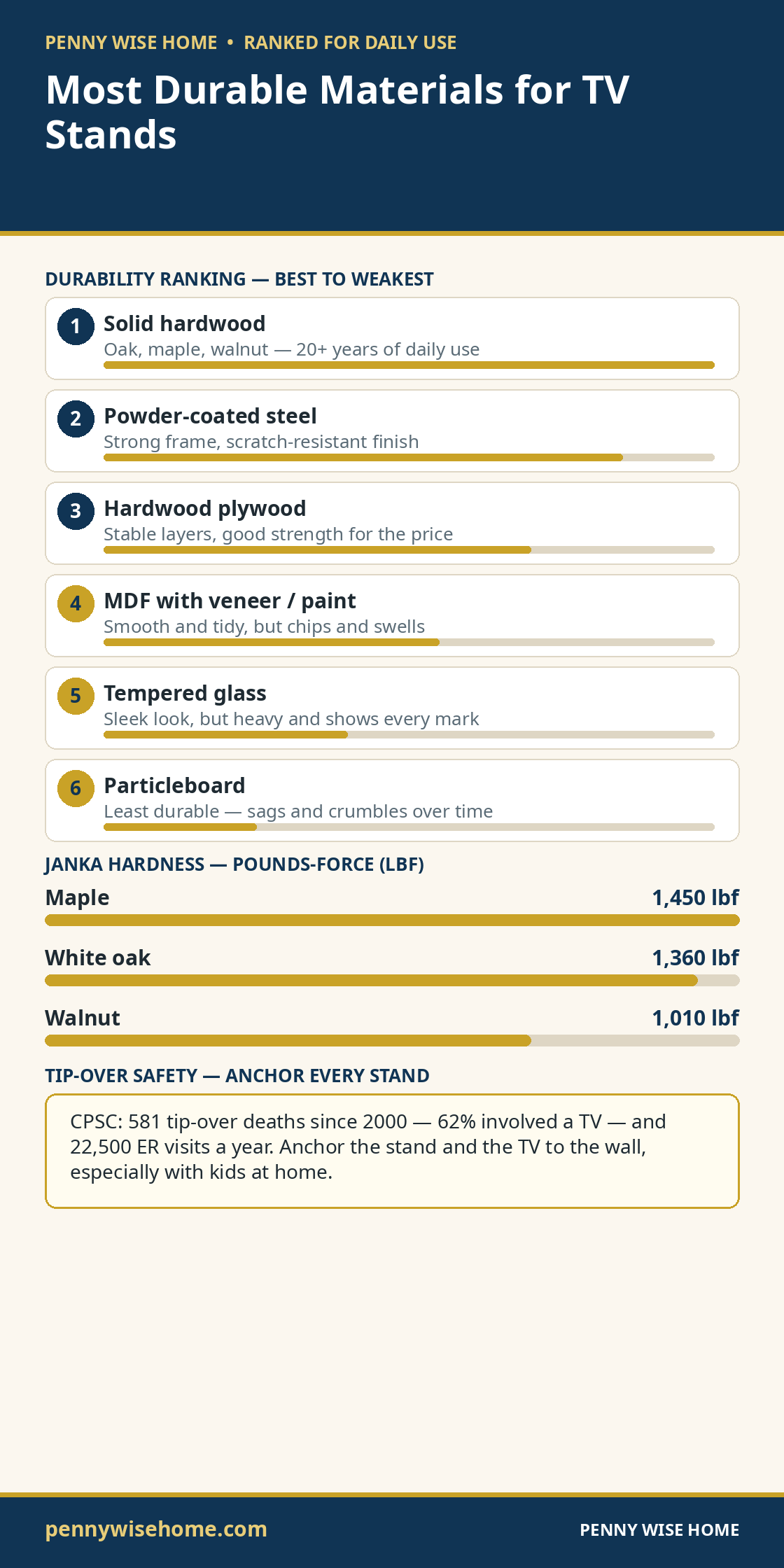
| 1 | Solid hardwood (oak, maple, walnut) | Excellent | Good (with finish) | Sand & refinish | 20+ years |
| 2 | Powder-coated steel frame | Excellent | Very good | Touch-up paint | 15–20+ years |
| 3 | Hardwood plywood | Very good | Good | Limited (thin veneer) | 15+ years |
| 4 | MDF with veneer or paint | Fair | Poor at edges | Hard | 7–12 years |
| 5 | Tempered glass (with metal frame) | Excellent | Excellent | Not repairable | Long, if it never breaks |
| 6 | Particleboard with laminate | Poor | Very poor | None | 3–6 years |
Key takeaway: For a stand you’ll use every day for a decade, pick solid wood or a steel frame. Everything else is a compromise.
1. Solid Hardwood: The Most Durable TV Stand Material Overall
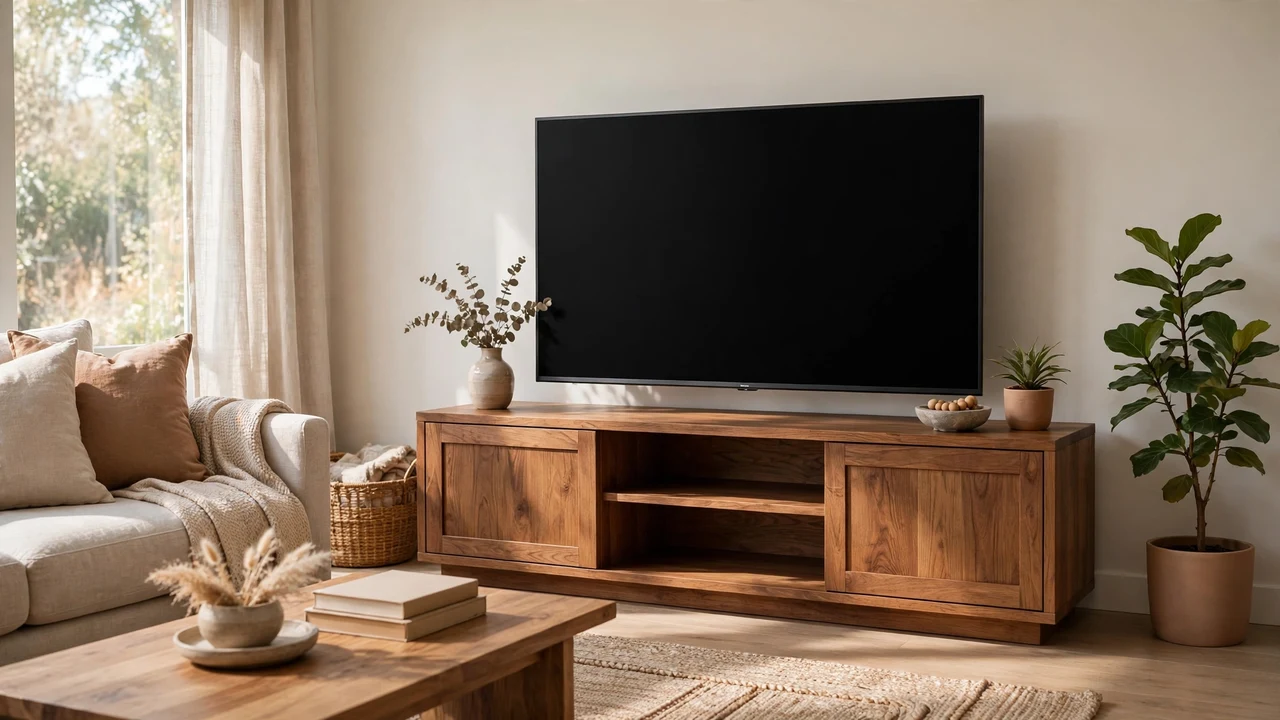
Solid hardwood tops the list of the most durable materials for TV stands because it’s strong, repairable, and handles heavy loads without sagging. Species matters.
On the Janka hardness scale, hard maple scores about 1,450 lbf, white oak about 1,360 lbf, and black walnut about 1,010 lbf. Pine sits far lower, so it dents easily.
Picture this: your toddler bangs a toy car on the top. Oak shows a faint mark. Pine shows a crater.
- Con: Heavy. A 60-inch solid oak console can top 100 pounds empty.
- Con: Wood movement. Solid tops expand and shrink with humidity, so cheap builds can crack if the top is screwed down too tightly.
- Con: Price. Expect to pay several times more than particleboard.
Who Should Skip This: Renters who move every year up narrow stairs, and anyone on a strict starter budget.
2. Powder-Coated Steel: Best for Heavy TVs and Gear
A steel frame doesn’t sag, warp, or swell. Pair it with a wood or stone top and you get one of the most durable TV stand setups for daily use — especially with big, heavy screens.
- Con: Cheap welds and thin tubing wobble. Shake the stand in the store; if it racks side to side, pass.
- Con: Open designs show every cable and collect dust on the shelves.
- Con: Chipped powder coat on cheap stands can rust in humid rooms.
Who Should Skip This: People who want closed storage to hide consoles and clutter.
3. Hardwood Plywood: The Smart Middle Ground
Here’s the catch most shoppers miss: good plywood is not the same as cheap “engineered wood.” Cross-layered veneers make plywood stiff and stable. It holds screws far better than particleboard and resists sag over wide spans.
- Con: The face veneer is thin, so deep scratches can’t be sanded out.
- Con: Exposed edges need banding or they look raw and can splinter.
Who Should Skip This: Buyers who want a heirloom piece they’ll refinish in 20 years.
4. MDF: Smooth, Cheap, and Picky About Water
MDF (medium-density fiberboard) paints beautifully and doesn’t warp like solid wood. That’s why it’s everywhere in modern media consoles.
- Con: Shelves sag under heavy gear over time, especially on spans wider than about 30 inches without support.
- Con: Water ruins it. A spilled drink on an unsealed edge can swell permanently.
- Con: Screw holes strip if you reassemble it.
Who Should Skip This: Anyone who moves often or keeps plants and drinks on the TV stand.
5. Tempered Glass: Tough Until It Isn’t
Tempered glass resists scratches and cleans in seconds. It’s strong under weight. On the flip side, it fails dramatically.
- Con: A hard edge hit can shatter the whole panel into pebbles.
- Con: Fingerprints and dust show constantly.
Who Should Skip This: Homes with toddlers, rambunctious dogs, or kids who play active video games near the stand. See our pet-friendly home guide for safer layouts.
6. Particleboard: The Least Durable TV Stand Material
Particleboard is wood chips and resin pressed into panels. It’s the cheapest option — and the first to fail under daily use.
- Con: Sags under heavy TVs and AV receivers within a few years.
- Con: Swells and crumbles when wet. No fix.
- Con: Cam-lock hardware loosens every time you move it.
Who Should Skip This: Anyone placing a 65-inch or larger TV on it, or planning to keep it more than a few years.
How to Size a Durable TV Stand for Daily Use
Now, you might be wondering how big and how strong your stand needs to be. Use these rules of thumb.
- Width: Pick a stand at least as wide as the TV’s base — ideally a few inches wider than the screen itself for visual balance.
- Weight rating: Check the manufacturer’s top-load rating. Add the TV, soundbar, and anything else on top, then leave a margin.
- Height: Aim for the center of the screen to sit near eye level when seated, often around 40–42 inches from the floor.
- Ventilation: Consoles and receivers need airflow. Look for cutouts in back panels or open shelves.
- Cord access: Grommet holes keep you from yanking cables over sharp edges.
Short on space? Our space-saving furniture for studio apartments guide includes slim media units that still hold real weight.
Don’t Skip This: Anchor Your TV and Stand
That brings us to the biggest mistake people make: trusting a heavy stand to stay put. The CPSC counted 581 tip-over deaths involving furniture, TVs, or appliances since 2000, and 62% involved a television. An estimated 22,500 people a year visited ERs for tip-over injuries from 2018 to 2020.
- Strap the TV to the wall or stand with an anti-tip kit.
- Anchor tall stands and consoles to a wall stud.
- Keep remotes and toys off the top so kids don’t climb for them.
The CPSC’s Anchor It! campaign walks you through installation step by step. Renters, holes are patchable — your landlord will take a filled anchor hole over an accident every time.
Daily Care by TV Stand Material
Even the most durable materials for TV stands wear faster without basic care. Here’s what each one needs.
| Material | Weekly care | Avoid |
|---|---|---|
| Solid hardwood | Dust with a soft, damp cloth | Silicone polish, standing water |
| Powder-coated steel | Wipe with mild soap and water | Abrasive pads that chip the coating |
| Plywood / MDF veneer | Dry dusting, coasters for drinks | Wet cloths on edges |
| Tempered glass | Glass cleaner on a microfiber cloth | Hard knocks on edges and corners |
| Particleboard laminate | Dry dusting only | Any moisture, overloading shelves |
Pro tip: Leave a few inches behind the stand for airflow. Hot consoles trapped in closed cabinets can dry out finishes and shorten electronics life.
Bottom Line on the Most Durable Materials for TV Stands
If you want the most durable materials for TV stands in daily use, go solid hardwood or a powder-coated steel frame, and treat good plywood as the budget-friendly runner-up. Skip particleboard for anything holding a big TV. Then anchor it — durability means nothing if the stand tips.
Want a high-end look without the price? Try the tricks in our affordable home decor that looks expensive guide.
FAQs
Is MDF or particleboard better for a TV stand?
MDF is denser and smoother, so it holds up better than particleboard. Both are weak against water and heavy long-term loads.
What is the strongest wood for a TV stand?
Hard maple, white oak, and hickory are among the hardest common furniture woods. Oak and maple are the easiest to find in TV stands.
How much weight can a TV stand hold?
It depends on the model. Always check the manufacturer’s weight rating and include the TV, soundbar, and gear in your total.
Are metal TV stands durable?
Yes. Powder-coated steel frames resist sag and moisture well. Look for thick tubing and solid welds that don’t wobble.
Should I anchor my TV stand to the wall?
Yes, especially with kids or pets. Anchor both the TV and any tall stand to prevent tip-overs.