If you’re furnishing a small apartment on a budget, IKEA and Wayfair are usually the two names in your cart. Both sell affordable sofas that look good in photos. The real question isn’t IKEA vs Wayfair sofas; which looks better on the website. It’s which one still looks and feels decent after a year of you sitting, sleeping, and spilling coffee on it.
Short answer: for a sofa in the same budget range, IKEA is the safer bet for predictable quality, mostly because it’s one company making one product line to one standard. Wayfair can absolutely win, but only if you buy carefully, because “Wayfair quality” isn’t one thing. Here’s what actually separates them after real use.
The Core Difference: One Factory vs. A Thousand
This is the thing that explains almost everything else. IKEA designs and manufactures its own furniture, so a KLIPPAN or an EKTORP is the same sofa whether you buy it in Texas or Toronto. Wayfair is a marketplace. It lists sofas from thousands of third-party brands, which means quality swings wildly from one listing to the next, sometimes within the same price bracket.
Practically, that changes how you shop. With IKEA, you’re choosing between a handful of known models and can read years of consistent reviews. With Wayfair, you’re really evaluating a specific brand and product, and last week’s great buy tells you nothing about the sofa two listings down. If you want the broader breakdown across all furniture categories, our full IKEA vs Wayfair comparison for small apartments covers dressers, desks, and storage too.
Frame and Construction
A sofa lives or dies on its frame. A weak frame sags, creaks, and eventually breaks no matter how nice the fabric is.
IKEA’s budget sofas use a mix of particleboard, plywood, and some solid wood, engineered to a set spec. It’s not heirloom furniture, and IKEA is upfront that it’s built for a defined lifespan rather than decades. But because the spec is consistent, you know what you’re getting.
Wayfair’s range is wider in both directions. A cheap listing might use low-density fiberboard that flexes and wears fast. A pricier one from a reputable brand might use solid wood with real joinery that outlasts anything IKEA sells. The catch is you often can’t tell which you’re buying without digging into the product specs, and many budget Wayfair listings don’t disclose enough to judge.
One honest limitation for both: neither survives being taken apart and reassembled across multiple moves. Flat-pack and marketplace furniture is built for one assembly, and structural rigidity drops each time you break it down and rebuild it.
Cushions and Comfort Over Time
Comfort on delivery day is easy. The test is month six, when a bad cushion has gone flat and turned your sofa into a bench.
IKEA generally uses polyurethane foam, with higher-resilience foam in its mid-tier models, which holds its shape better and resists body impressions. It’s firmer than plush memory foam, but it stays supportive longer. IKEA also publishes foam density and runs abrasion tests on its fabrics. Its FRIHETEN sleeper, for example, uses fabric tested to 40,000 rub cycles, well above the roughly 15,000-cycle standard for everyday home use.
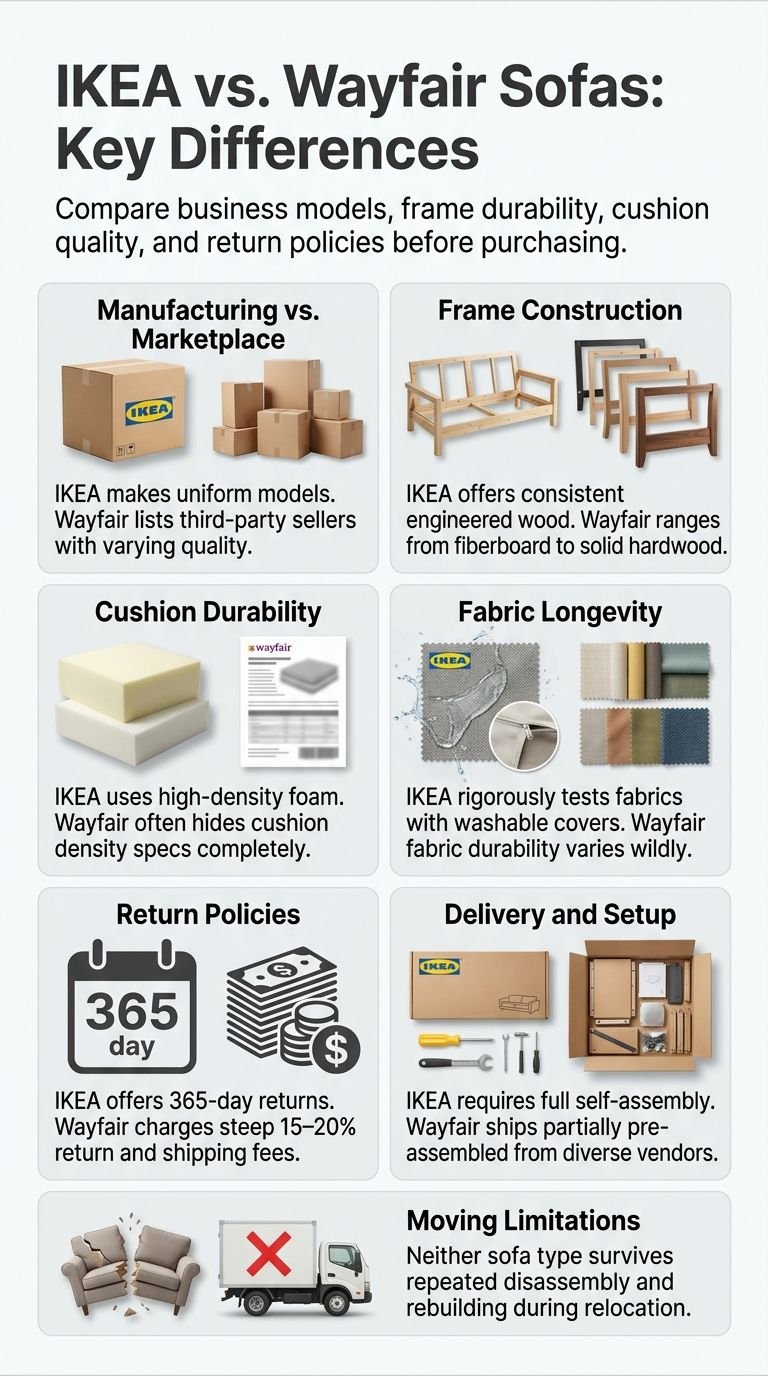
Wayfair’s cushions depend entirely on the price point and brand, and here’s a specific frustration: many Wayfair listings don’t disclose foam density at all. Without that number, you’re guessing how the cushions will hold up, and low-rub-count fabric on a cheap listing can wear through far faster than a tested IKEA cover.
Fabric and Everyday Durability
For upholstered furniture specifically, the consistency gap widens. Because IKEA controls its whole line, its fabrics are tested and repeatable, and many models offer removable, washable covers, which is a genuine advantage when you spill something or the cover fades.
On Wayfair, upholstery quality is the least predictable category of all. This is the area where reading reviews carefully matters most, and where the “just buy the cheapest one” approach burns people. A $400 Wayfair sofa with thin, low-durability fabric genuinely may not last half as long as a comparable IKEA model.
Price, Returns, and the Fine Print
On sticker price the two are close in the budget tier, so the tiebreakers are the policies around the purchase.
IKEA’s return window is generous (365 days on new, unused items), and IKEA Family members can claim the difference back within 90 days if the price drops after they buy. Those two policies quietly de-risk the purchase.
Wayfair runs frequent sales and sometimes beats IKEA on a specific item, and it delivers to your door, which matters if you don’t have a car or a nearby store. But returning furniture is where marketplace shopping gets painful: restocking and return fees on furniture commonly run 15–20% of the item’s price, plus pickup fees, and a bulky sofa is exactly the kind of thing you don’t want to ship back. Damaged-on-arrival reports also show up more often with marketplace items, since quality control varies by supplier.
Delivery and Assembly
IKEA is flat-pack: cheaper to ship, but you’re building it, and a wobbly, poorly assembled IKEA sofa is not a durable one. Assembly quality directly affects how long it lasts, so take your time with it.
Wayfair items arrive from different suppliers, so delivery experience varies, but many sofas come largely pre-assembled, which is a real plus if you dread the Allen-wrench marathon. The trade-off is that boxes are bigger and heavier to maneuver into a small apartment.
So Which Should You Buy?
Buy IKEA if you want predictable quality for the price, you value the easy return policy, you’re comfortable assembling it, and you like the option of washable covers. It’s the lower-risk choice for a first sofa in a small space.
Buy Wayfair if you want a specific style, color, or size IKEA doesn’t carry, you’re willing to research the exact brand and read reviews closely, and you’d rather have it delivered mostly assembled. It’s where you go when IKEA doesn’t have “the one,” and it can genuinely outlast IKEA if you buy up into solid-wood territory.
There’s no universal winner here, and anyone who tells you otherwise is selling something. The honest rule: IKEA gives you a reliable floor, and Wayfair gives you a higher ceiling and a wider floor. For a small living room, also look at whether a sofa bed makes more sense than a standard sofa. Our picks for budget sleeper sofas for small living rooms and our guide to space-saving furniture for studio apartments both cover models from each retailer.
Frequently Asked Questions (FAQs) on IKEA vs Wayfair Sofas
1. Is IKEA better quality than Wayfair?
For sofas in the same budget range, IKEA offers more predictable quality because it makes its own consistent product line. Wayfair’s quality varies by the third-party brand you buy, so it can be worse than IKEA on a cheap listing or better on a solid-wood one. IKEA is the lower-risk choice; Wayfair has the higher ceiling.
2. Which lasts longer, an IKEA or Wayfair sofa?
A well-assembled IKEA sofa typically outlasts a cheap Wayfair listing, but a high-end solid-wood sofa from a reputable Wayfair brand will usually outlast almost anything IKEA sells. In the budget-to-mid range they’re roughly comparable, so read the specs and reviews on the specific Wayfair item.
3. Is Wayfair or IKEA cheaper for a sofa?
They’re close in the budget tier. Wayfair runs frequent sales that can win on a specific item, while IKEA has more consistent everyday pricing plus a 90-day price-drop refund for members. Factor in return fees, which are higher and more painful with Wayfair.
4. Do IKEA sofas hold up if you move a lot?
Not especially. Flat-pack sofas are built for one assembly, and structural rigidity drops each time you disassemble and rebuild them. If you move often, look for a sturdier solid-wood option or a model designed to come apart cleanly.
Sources & further reading
- IKEA return policy — IKEA US
- Wayfair return policy — Wayfair Help Center
- Biggest Mistakes to Avoid When Buying a Couch — Consumer Reports